← back to taxus.nl home
NLEN
Kwekerij Van Heeswijk

The Taxuspedia™

for (almost) every answer to your yew questions
Everything you ever wanted to know about yew.
11 chapters · 141 questions

We have been getting the same questions about yew for years. How deep does it go in the ground, what to do about yellowing, how many plants you need per metre of hedge. Good questions, and they deserve an honest answer rather than a sales pitch. That is why we have gathered our knowledge here in one place. No theory from a textbook, just our own experience from daily practice.

New to yew? Start here

A short route through the basics, in the right order.

Contents

01About yew4 questions 02Planting yew18 questions 03Position17 questions 04Care14 questions 05Growth and development8 questions 06Species and choice16 questions 07Problems and diseases15 questions 08The yew calendar for pests and problems3 questions 09Moving, repairing and renewing4 questions 10Yew and safety8 questions 11Buying and choosing12 questions ·In closing: common mistakes with yew ·Yew through the ages22 questions·In plain wordsTerms·Quick referenceReference·Photo galleryPhotos·IllustrationsDrawings·ColophonAbout

Most of the answers here are the same ones we give when you come to collect your plants. What we tell you depends on what you ask.

All those questions over the years are what grew into this reference work, the Taxuspedia!

Short answerYew is an evergreen conifer, a needle-bearing plant from the yew family. It stays green all year, grows slowly but lives to a great age, and tolerates shade and pruning like almost nothing else. That is why it is the classic hedge and topiary plant.

Yew is a conifer, a needle-bearing plant, and belongs to the yew family, the Taxaceae. It is evergreen, so it does not drop its needles in winter. In the wild, yew grows naturally across much of Europe, including the Netherlands.

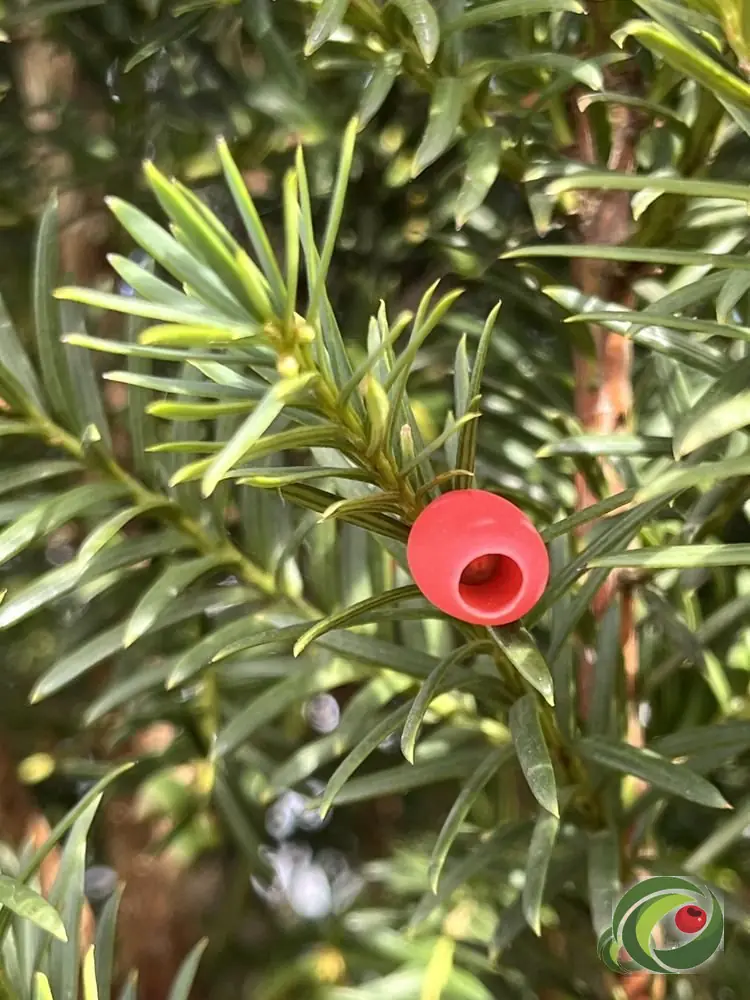
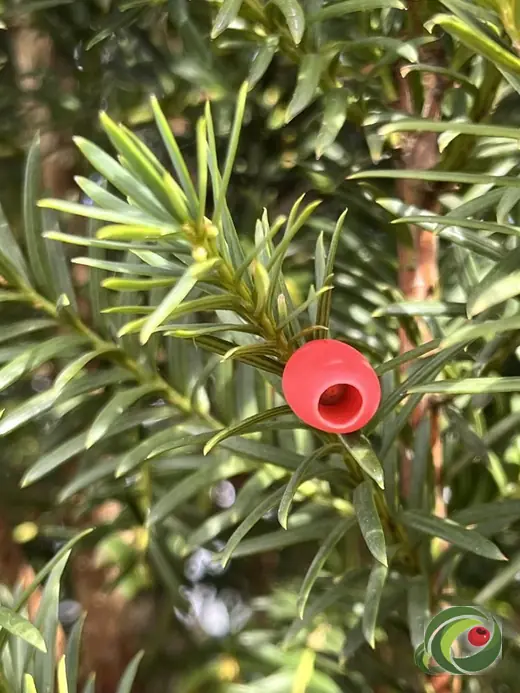
Unlike most conifers, yew does not produce cones. On a female plant the seed sits in a soft, red covering, which is what most people call the berry. Male and female plants are separate. You can read more about that under the question 'Can you tell whether a yew is male or female?'.

Yew grows slowly, but reaches a great age. Some trees in Europe are more than a thousand years old. It tolerates deep shade and hard pruning, and it is exactly that combination that makes it so suited to a tight hedge or topiary. Almost every part is poisonous, only the red flesh is not. You can read about that under the question 'Is yew poisonous?'.

You will sometimes hear yew called a shrub or bush. That is not quite right. A shrub is not a plant species but a growth form, a woody plant that branches low without a clear trunk. By nature, yew is not that. Leave it alone and it slowly becomes a small tree. But because in the garden you almost always keep it low and as a hedge, it behaves like a shrub, and that is how the garden centre sells it too. Hence the label shrub turning up now and then. Botanically it stays a conifer that you use as a shrub.

TipYew is the name for the whole group. The species most often used as a hedge here is the common or native yew, Taxus baccata. You can read about the difference with the other widely used species under the question 'What is the difference between Taxus baccata and Taxus media?'.
Short answerBecause it has almost everything you want from a good hedge. Green all year, dense by nature, and it takes hard pruning without going bare. On top of that it grows in shade and lasts for generations. Few plants can do all of that at once.

Yew is evergreen, so your hedge stands in full leaf even in the middle of winter. And it branches very densely by nature. That makes it an excellent screen against prying eyes, wind and noise, all year round.

What is special is that yew does not mind hard pruning. Where many plants stay bare if you cut into the old wood, yew simply shoots again from it. That lets you keep it tight and in shape, and you can also clip it into balls, pyramids or other figures. For tight, formal hedges there is hardly a better choice.

On top of that, it grows in spots where many other hedging plants give up, including deep shade. And a yew hedge is not a temporary thing. Well looked after, it lasts for decades, sometimes generations. So you are really planting it for the long term.

It is not for everyone. It grows slowly, so patience is needed, and it is poisonous. When yew is not the most sensible choice, you can read under the question 'When is yew not the best choice?'.

TipIf you are torn between yew and a faster conifer, remember that speed also means maintenance. A fast hedge has to be cut often to keep it in check. Yew grows quietly, but stays neat for a long time because of it, and usually needs trimming only once a year.
Short answerYes, in two ways at once. A yew lasts a very long time, sometimes generations, and does not need replacing every so often like a fence. It asks for little fertiliser, rarely a pesticide, stays green all year and offers shelter to wildlife. For a lasting green boundary it is hard to find a more sustainable choice.

The strongest sustainability argument is its lifespan. A yew can last for decades, and in the right conditions centuries. It even shoots again from bare, old wood, so a neglected hedge can often be cut back and rejuvenated instead of dug out. So you plant it, in effect, once, for the long haul. A wooden fence you replace a few times in that same span.

On top of that, it needs little. Yew is tough, asks for little fertiliser and rarely a pesticide, and grows slowly, so it also produces fewer clippings than a fast grower. It stays green all year, catches some wind and dust, and stands firm enough to ride out a good storm.

And a living hedge does more than a fence. A yew offers birds a place to nest and, on female plants, berries, and gives insects shelter. It takes up CO2 for as long as it grows, and it often replaces wood, concrete or plastic. Another nice thing is that a yew does not have to go as it ages. Where many garden plants eventually open up or age badly, a yew only becomes fuller and more characterful.

Whether it is the single most sustainable plant, we would not dare to say, because that depends on what you measure. But for a hedge you want to keep for decades, and with a bit of luck generations, yew is one of the most sustainable choices there is. Slow, solid and lasting, exactly what it is good at.

TipIf you really want to plant for the long haul, see to good soil and drainage from the start. A yew that sits airy and not too wet lasts the longest. The plant is durable, but the start decides how much of that it delivers.
Short answerThat depends on what you mean. The plant itself is a natural, native species, but 'organic' says nothing about the plant. It is about how it was grown, and that is a protected term you may only use with certification. We are not certified organic, so we do not call our yew that either.

Taxus baccata occurs naturally in Europe, so as a plant it is about as natural as it gets. But 'organic' says nothing about the species. It is a legally protected term about the growing method and about which products are allowed in it. You may only call a plant organic once the grower is certified for it, in the Netherlands through SKAL.

We do not hold that certificate, so we do not call our yew organic. Yew is a tough plant that rarely needs a pesticide, and it asks for little feeding of its own accord. In open-ground growing a light hand is the norm, at most a little fertiliser now and then when a plant really needs it. Natural and sparing with products, then, but without an organic label.

It comes down to not mixing up two things. Natural and sustainable is something other than certified organic. The first is in the plant, the second is in the paperwork. We like green, not green talk. We do not do greenwashing.

TipNot organic does not mean unsustainable here. Why yew is in fact a very sustainable choice, you can read under the question 'Is yew a sustainable plant?'.
↑ Back to contents
Short answerFrom September to April, preferably in autumn. The earlier in the season, the better the start.

Field-grown yew is best planted from September through to April, as long as it is not freezing too hard. We advise starting from the middle of September, provided it is no longer too warm. That varies from year to year. One year you can start in mid-September, another year it is still too warm then and you have to wait a little.

TipIn autumn the roots still have time to establish before winter sets in, so the plant can grow straight on in spring. The earlier in the season you plant, the better the start.
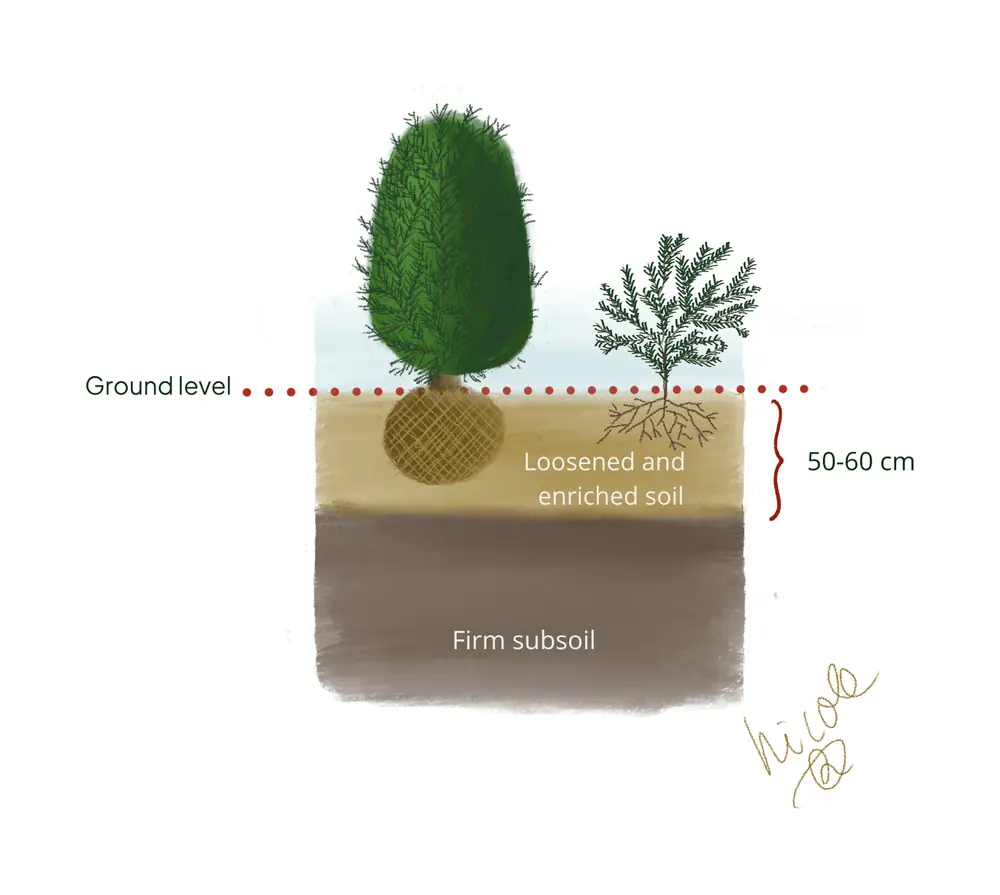
Short answerRoot-balled plant: the top of the root ball level with the ground, with a small strip of hessian still showing. Bare-root stock: the top root about a thumbnail deep (1.5 to 2 cm). Not too deep, that is the most common mistake.

When planting there are two things that are not the same. How deep you loosen the soil, and how deep the plant itself ends up standing. You always loosen the soil deeper than the planting hole itself, so the roots can easily work their way down afterwards.

Loosen the soil to about 50 to 60 centimetres deep. If there is a hard or obstructive layer underneath, dig deeper. Otherwise water sits there and the roots cannot get through. The guide measurements per plant size are in the table under the question 'What planting distance should I use for a yew hedge?'.

If you are planting bare-root stock, dig a trench deep and wide enough for the roots, around 25 to 30 centimetres. You have no root ball as a reference point, so keep the top root about a thumbnail deep below the ground, around 1.5 to 2 centimetres. Here too, better slightly too shallow than too deep.

With a root-balled plant the depth of the hole depends on the height of the root ball, and the width on the width of the root ball. The top of the root ball comes level with the ground. The hessian sack may stay around the root ball, it rots away in the soil by itself. Keep a small strip of the hessian showing above the ground. That is the soil line, the height at which the plant stood in our open ground. Plant it back to exactly that line.

How wide to make the planting hole or trench, you can read under the question 'How wide should my planting hole or trench be?'.

In all cases, do not plant too deep. Planting too deep is a common mistake and can harm the plant.

TipWork the soil back so a small dish forms around the stem, not a mound. That dish lets water sink to the roots instead of running away from the plant.
TipAre you planting bare-root stock? Before planting, stand the plants in a tub of water for ten minutes first. That lets the roots soak themselves full and gives the plant a much better start.
TipKeep the plants out of the sun and wind while planting. Bare roots dry out far faster than you think, certainly on a sunny or windy day. Lay the plants that are not yet up next in the shade, covered with a damp cloth if you can.
TipAfter planting, press the soil around bare-root stock down lightly. That way the soil meets the roots well and no air pockets are left where the roots dry out. Do not stamp too hard, because then you press all the air out of the soil and make it harder for the roots instead.
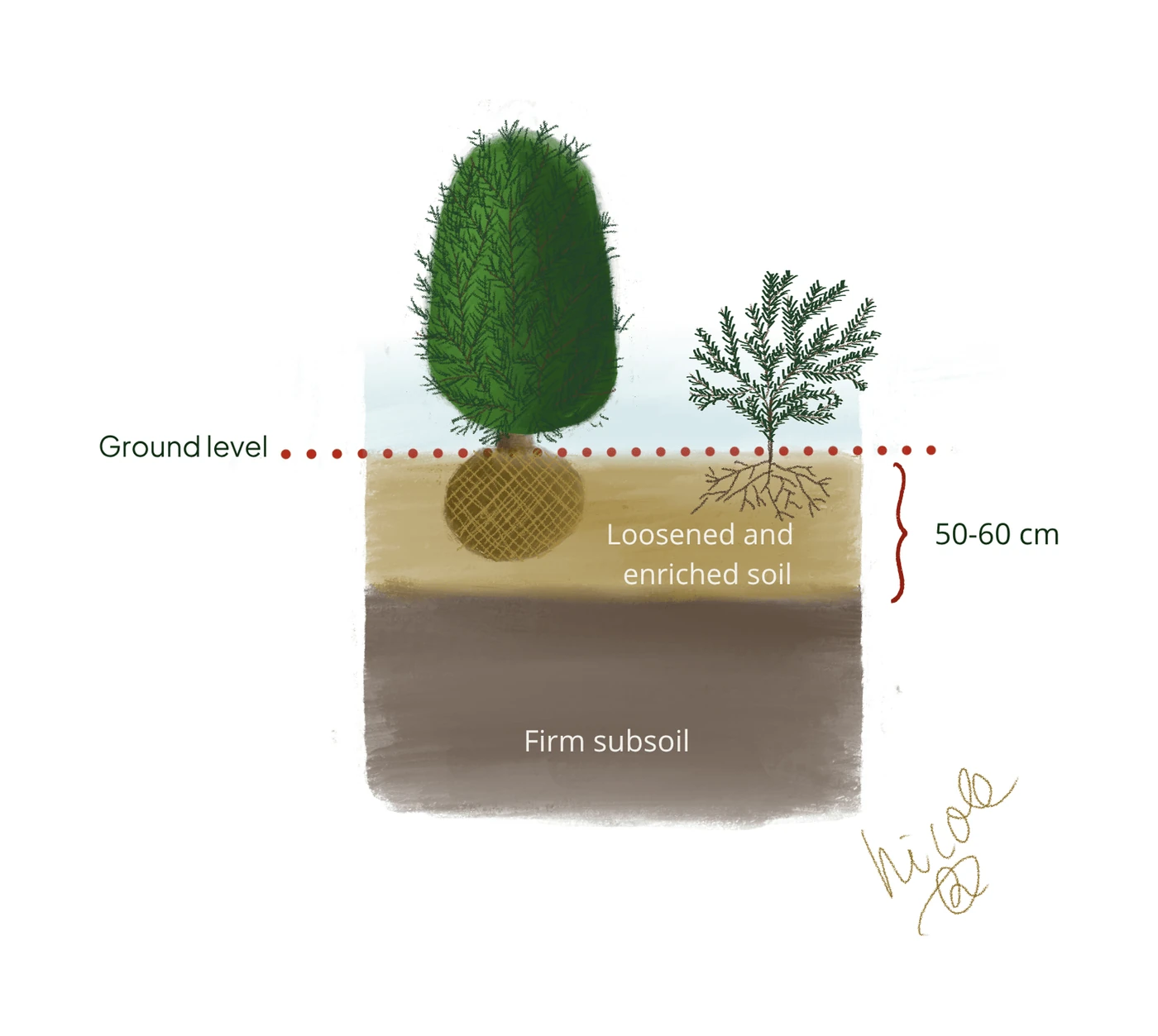
Cross-section of a planting hole: a root-balled yew and a bare-root yew at ground level, in 50 to 60 cm of loosened, enriched soil above the firm subsoil.
Plant at ground level in loosened, enriched soil 50 to 60 cm deep, on the firm subsoil.
Short answerA single plant goes in a generous hole, a little wider than the root ball. A hedge is planted in a continuous trench. The right width depends on the size, and you always loosen the soil underneath well.

It depends on what you are planting. A single yew goes in a separate planting hole. A hedge is not planted in separate holes but in a continuous trench, so the roots share the same loosened soil from plant to plant.

For a single plant, make the hole a little more generous than the root ball. A root ball of around 30 centimetres wide goes in a hole of about 50 centimetres. That way there is loosened soil all around for the roots to grow into easily.

For a hedge you dig a trench. The minimum width per plant size is in the table under the question 'What planting distance should I use for a yew hedge?'. You will also find there how deep to loosen the soil.

In both cases, loosen the soil under and beside the plants well. If there is a hard or obstructive layer, dig deeper. The plant does not end up any deeper, you only make the soil around it easier to root into.

TipIf the root ball has turned out larger, there is work to do. So keep your spade to hand.
Short answerNo, leave the hessian on, it rots away in the soil by itself. If there is nylon around the root ball, do take that off.

No, the hessian sack may simply stay around the root ball. That is even better. The hessian holds the root ball together during planting and rots away in the soil by itself. The roots grow through it without trouble. We get this question very often, because it feels contradictory to put packaging into the ground. But hessian is a natural product and breaks down within a few months.

Watch out. Very occasionally there is a nylon sack around the root ball instead of real hessian. That does have to be removed before planting, because nylon does not rot in the soil and blocks root growth. We always point it out explicitly when this is the case. Not sure? Feel the material. Real hessian feels rough and fibrous, nylon feels smoother and tighter.

TipWith us there is never plastic around the root ball, only hessian or very occasionally nylon. You will not come across more packaging than that.
Short answerBare-root stock: 5 per metre. Root-balled plants: 2.5 to 4 per metre. Better a little more generous than too tight.

That depends on the size of the plants:

  • Bare-root stock (20 to 30 cm and 30 to 50 cm). 5 plants per linear metre
  • Plants with a root ball. 3 to 4 plants per linear metre
  • Very large plants with a root ball. about 2.5 plants per linear metre

If you want to know it exactly per size, you can use this table. It also shows how deep to loosen the soil and the minimum width of the planting trench.

Type & sizeLoosen to depthMinimum trench widthPlants per metre
Bare-root 20 to 30 cm50 cm20 cm5 plants
Bare-root 30 to 50 cm50 cm25 cm5 plants
Root ball 40 to 60 cm50 to 60 cm30 cm4 plants
Root ball 60 to 80 cm50 to 60 cm35 cm3.5 to 4 plants
Root ball 80 to 100 cm50 to 60 cm40 cm3 plants
Root ball 100 to 120 cm50 to 60 cm45 cm3 plants
Root ball 120 to 140 cm50 to 60 cm50 cm2.5 plants
Root ball 140 to 160 cm50 to 60 cm55 cm2.5 plants

With a root ball the number also depends on the width of the plant and the size of the root ball.

And of course we do not supply half plants. Look at it this way. If you want to plant two linear metres of 140 to 160 cm, that works out at 5 plants.

Work out how many you need

Enter your size and hedge length, and you get the number of plants. This uses the same spacing as the table above.

25 plants needed
TipBetter to plant a little more generously than too tight. Yew grows dense enough to fill gaps, but too close together leads later to bare patches at the bottom as the plants take each other's light.
TipWhen planting, look at the shape of each plant, certainly with young stock. One is a bit broader and flatter, another a bit more compact. If you want a denser-looking hedge right away, turn the plants so the fuller side faces forward. From the street side the row then already looks dense, while the thinner sides face the neighbours in the row and fill in there by themselves. When you collect the plants, we will show you exactly.
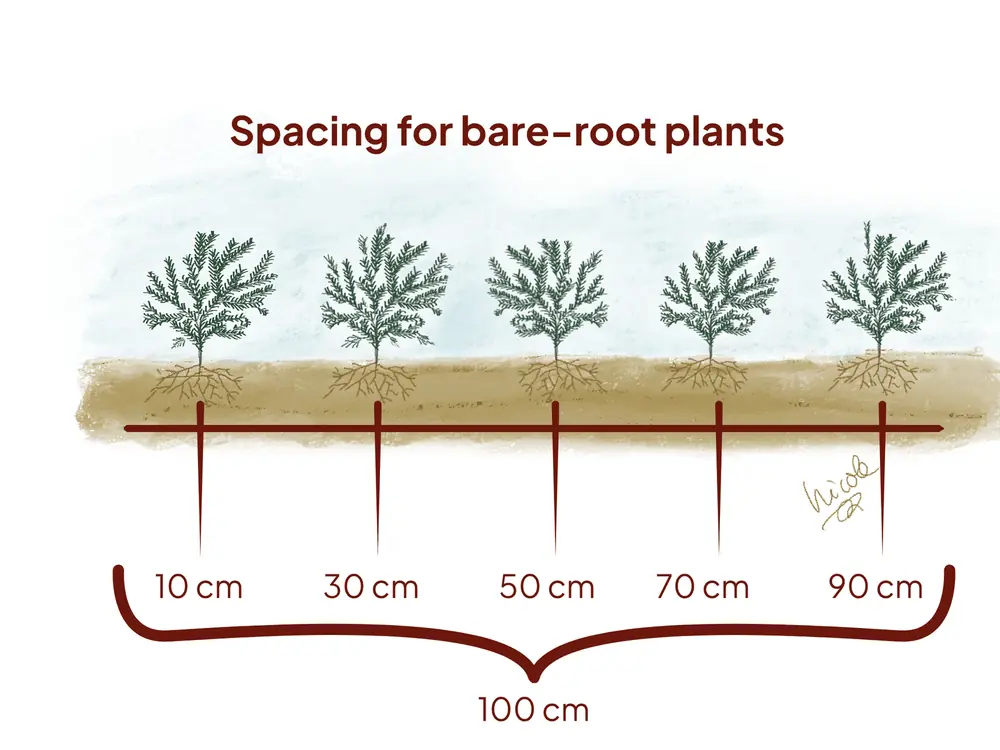
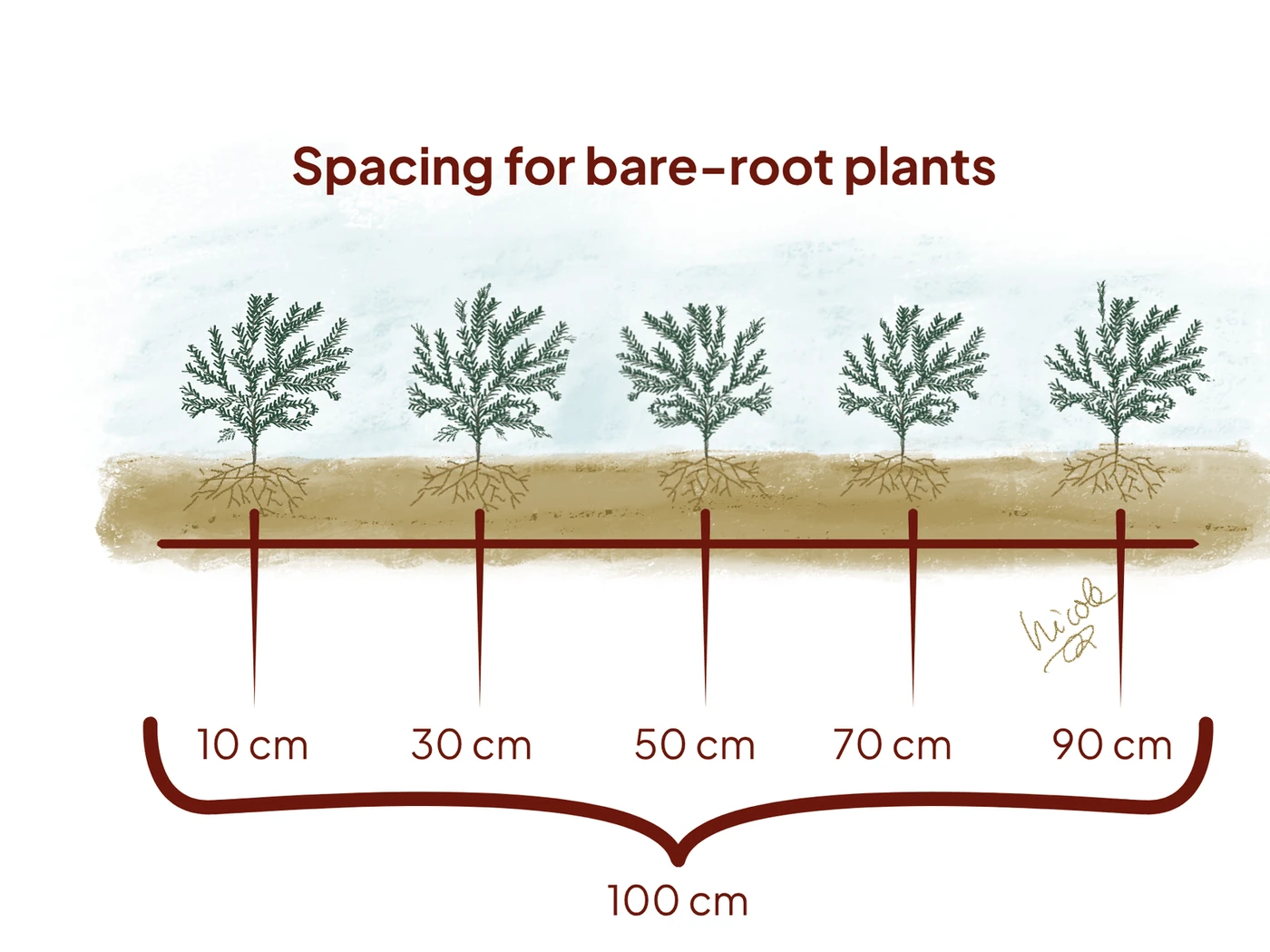
Short answerWith bare-root stock, 5 per metre, you place them at roughly 10, 30, 50, 70 and 90 cm. The middle one sits nicely in the centre at 50 cm. It does not have to be to the centimetre.

This mainly comes up with bare-root stock, where you place 5 plants per metre. It helps to picture how you spread them across the metre.

Measure from the start. You place the first plant at around 10 cm, then a new one every 20 cm. You then end up at roughly 10, 30, 50, 70 and 90 cm. About 10 cm is left at the start and at the end.

An easy anchor point: the middle plant sits exactly in the centre, at 50 cm. From there you set two to the left and two to the right, each 20 cm apart.

That margin on either side means the next metre joins on neatly. From the last plant to the first of the next metre is again about 20 cm, without two ending up too close together at the join.

It does not come down to the centimetre. Yew grows dense enough to even out small differences. See it mainly as a guide so your row looks even.

Planting plan for bare-root yew: five young plants evenly spaced within one running metre.
Bare-root plants go five to a running metre, about twenty centimetres apart.
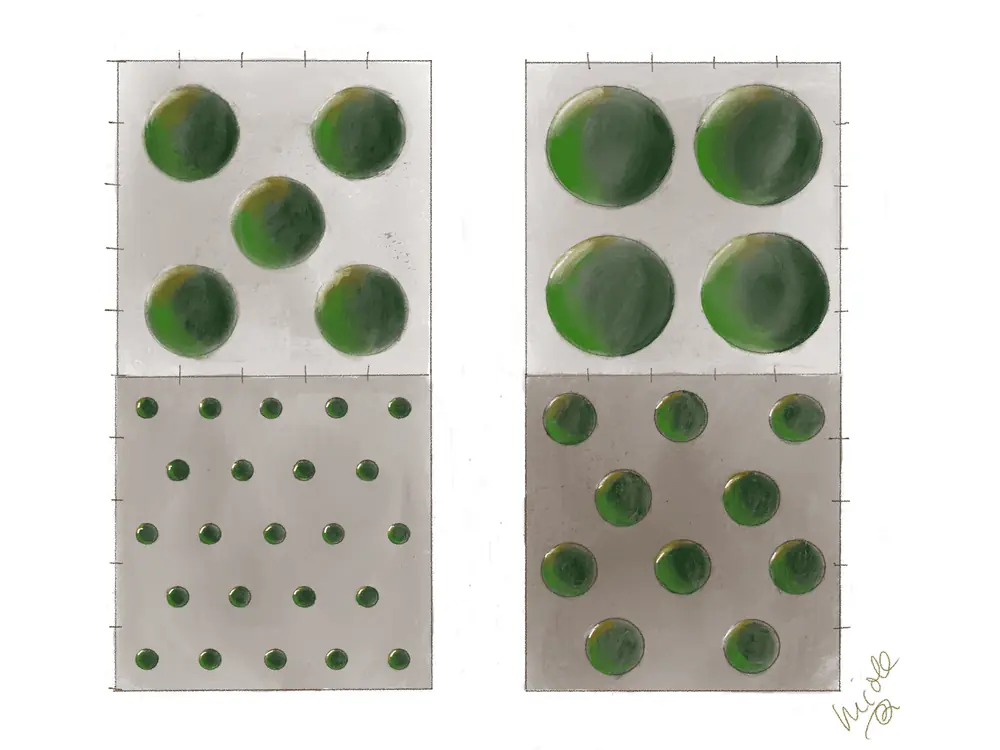
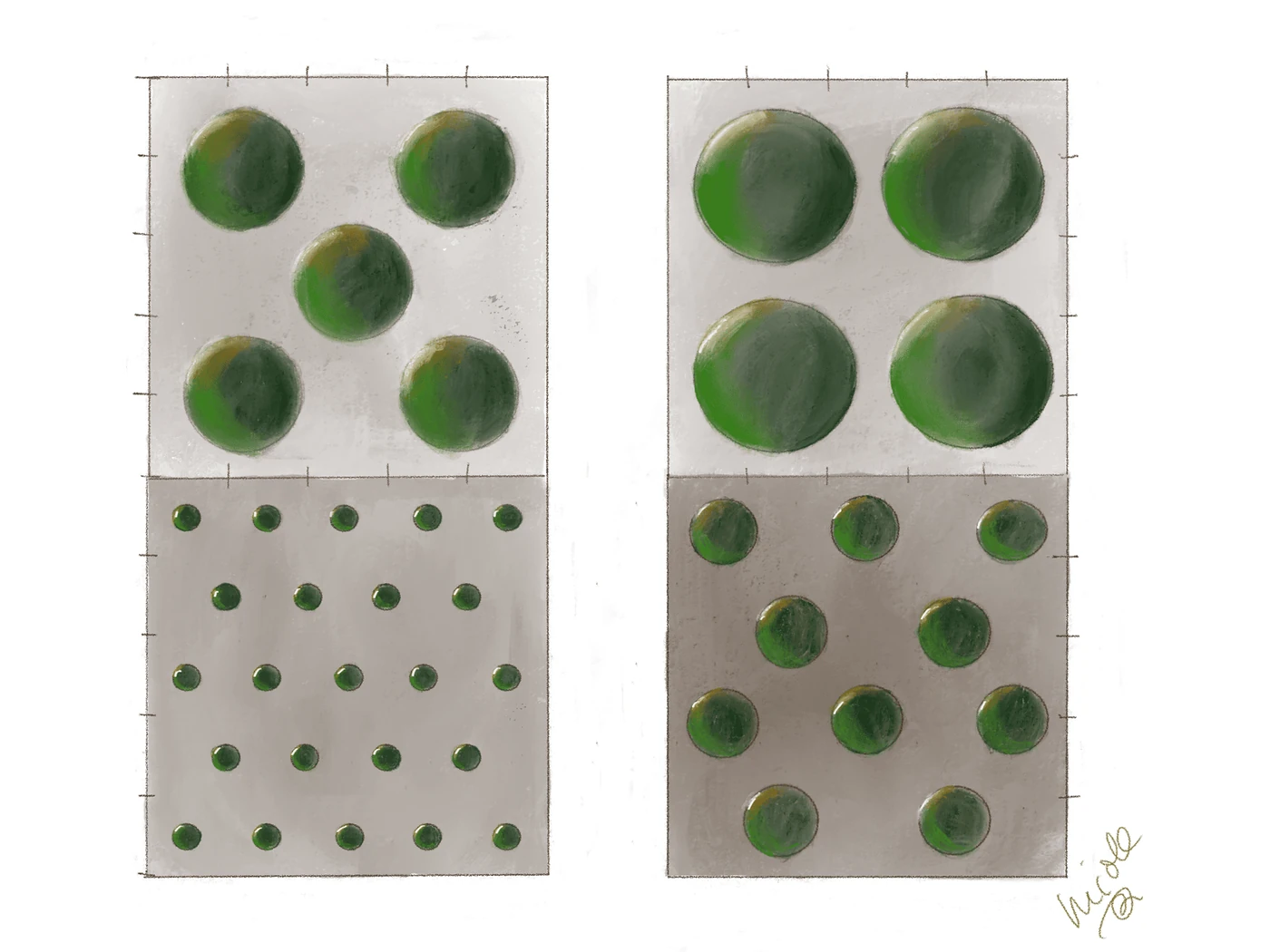
Short answerThe bigger the plant, the fewer you need. For a block of one metre by one metre that ranges from around 22 to 24 small plants, through 12 to 14 or 7 to 9 for the in-between sizes, to 4 or 5 large root-balled plants. Large plants are at height straight away, small ones are cheaper but ask for patience. And you always plant staggered, so the block grows dense faster.

How many plants you need depends mainly on the size. For a block of one metre by one metre, use roughly this:

  • Small, bare-root up to 40 cm. 22 to 24 plants
  • 40 to 60 cm, with root ball. 12 to 14 plants
  • 60 to 80 cm, with root ball. 7 to 9 plants
  • 80 to 120 cm, with root ball. 4 to 5 plants

You build a yew block in two ways, with a few large plants or with a group of small ones. Both work fine, it is mainly a matter of budget and patience. Large plants are at height straight away, you pay more for them but your block also looks like a block right away. Small plants are cheaper, you just have to give them time to fill out. If you cannot wait, start big. If you have patience and want to keep the cost in hand, small plants are the smart choice.

Do not set the plants in dead-straight rows directly behind one another. Far nicer and quicker to fill is the staggered pattern, where you offset each row relative to the last, so alternating. That has three advantages. The plants fill each other's gaps right away, you cannot see through the block, and every plant gets light from all sides. That gives healthier growth from the bottom up.

How exactly you set them out depends on the size. Small plants go in a few rows that stagger alternately. With the largest sizes you cannot even zigzag, because the root balls are so thick, often 30 to 40 centimetres wide, that no rows fit in a square metre. Then you work with a square. For four plants you put one in each corner, for five plants four in the corners and one in the middle, just like the five on a die. Your block is then equally full everywhere from day one.

Plants with a root ball establish faster and more safely than bare-root, because the fine hair roots sit protected in the soil. From size 60 to 80 you have a recognisable, compact block standing right after planting and a first trim.

TipJust after planting, cut the top tips of all the small plants to the same height, the leaders that is. That forces the young yew to branch out sideways instead of only shooting upward. Trim the sides lightly at the same time, then your block grows dense from bottom to top.
TipIf you are working with bare-root, plant it only between November and April, while the plant is dormant. Never in the warm summer months, because then the roots dry out. Keep the bare roots covered with a damp cloth or hessian until the last moment, also while carrying them. Those fine hair roots dry out beyond repair within a few minutes in wind or sun. Better no plastic, because under it they start to sweat if they lie there too long.
TipIf you are working with the largest sizes, do not dig separate holes for those four or five plants, but loosen a square area of one metre by one metre in one go, around 40 centimetres deep. That plants a good deal more easily.
TipNot sure about the size? Call or email us, we will happily think along with you.
Top view of four squares showing how to space yew in a block: small plants close together in a staggered pattern, larger plants further apart in a square of four or five.
The bigger the plant, the fewer you fit in a block and the wider apart they stand. Treat it as a guide, since a block is rarely exactly a metre.
Short answerYes, but sensibly. Always mix compost or good garden soil through the existing soil. Never put fertilised garden soil pure in the planting hole, and with autumn planting better not at all.

On most garden soils improving the soil is not strictly necessary, but it does help. Mix the dug-out soil with mature compost or good garden soil, so the ground becomes airier and easier to root into. On heavy clay, add coarse sand or lava granules for drainage. On poor sandy soil, extra organic matter is what matters, to hold moisture and feeding for longer.

Never use fertilised garden soil pure in the planting hole. It is too sharp for young roots and can scorch them. Always mix it well through the existing soil, so the transition to the surrounding ground stays gradual. Otherwise the roots stay stuck in a small, rich pocket of soil and do not grow out into the garden.

For autumn planting we do not use fertilised garden soil. Then you want rest and structure in the soil, not a growth spurt. Use compost or unfertilised garden soil. For spring planting, fertilised garden soil may be mixed with poor soil, but only in moderation.

TipNever throw pure potting compost, peat or fertilised garden soil into the planting hole. Pure fertilised garden soil is too sharp and can scorch young roots. Potting compost and peat hold too much moisture. Mix everything through the existing soil, then the roots grow outward instead of staying stuck in a too-rich pit.
Short answerYew does not tolerate wet feet. See to good drainage before you plant. Which approach works best depends on your soil type and situation. Every garden is different.

Yew makes one hard demand of the soil. The water has to be able to get away. If the plant stands with wet roots for long periods, it goes downhill and eventually dies. Good drainage is therefore not a luxury but a condition.

How you go about it depends on your situation. Sandy soil drains well by nature and rarely gives problems. Clay soil holds water and almost always calls for extra measures. A low spot in the garden is trickier than a slope, where the water runs off by itself.

Below is a rough overview of the options.

MeasureWhen suitable
Raising the planting bedFor slightly to moderately poor drainage
Improving the soil over a larger area, not just the planting holeFor clay soil, small scale
Raising with a border or retaining wallFor a structurally high water table
Laying drainage pipesFor larger plots or serious waterlogging
Choosing a different locationIf drainage is not feasible or too costly

For small plantings you can often do something yourself by improving or raising the soil locally. For larger hedges or structurally wet ground it is wise to have a landscaper or soil specialist take a look before you start. That prevents disappointment afterwards.

Every situation is different, and in the end you know your own garden best. We are happy to advise on the choice of plants. The soil is your own responsibility.

TipMore on the ideal soil for yew you can read under 'What soil is best for yew?'. Improving the soil in the planting hole is covered by 'Should I improve the soil when planting?'.
Short answerYou can, but refresh the soil in the trench first. An old hedge leaves the soil tired, which is called soil sickness. With fresh soil, a different spot or a different species, you give the new hedge a fair start.

If the same plants have stood in a spot for years, the soil becomes, as it were, worn out. Certain nutrients are used up, and disease germs, fungi and nematodes that prey on that species build up. We call that soil sickness. It does not only happen with yew, but with almost any hedge you replace with the same or a related species. A new hedge in exactly the same spot then grows with difficulty, even if you do everything else right.

The surest solution is to refresh the soil where the new plants go. Dig the trench out generously and also remove the old roots well, because leftover roots can harbour fungi and get in the way of the new roots. Fill with fresh, clean soil, mixed with mature, clean compost if you like. Do not use compost made from the prunings of the old hedge, because the same germs can be in it. That way the roots start in clean soil.

If you cannot or do not want to refresh the soil, there are two other routes. Plant the new hedge a good way beside the old line, in soil where that same species did not stand before. Or choose a different species from what was there, because soil sickness is largely species-specific. A different hedging plant suffers far less from the germs that prey on the previous species.

TipReplacing an old hedge? Count the fresh soil into your plan straight away. It is a small effort beforehand, and it saves you a hedge that keeps struggling for years.
Short answerAt the garden centre they sit side by side, but they are different products. Potting compost is made for pots and containers, not for open ground. Garden soil and planting soil are meant for improving your garden soil. Fertilised garden soil is garden soil with manure through it, stronger but also sharper. For planting yew you mix everything through your own soil, and you never use fertilised garden soil pure.

The bags look alike and so do the names, but they are different things for different purposes. Pick the wrong one and your yew can suffer for it. Below you see per type what it is and what you use it for.

TypeWhat it isWhat you use it for
Potting compostAiry soil often with peat, holds a lot of moistureOnly for pots and containers. In open ground it becomes a wet sponge where the roots stay stuck
Garden soilFirmer soil, meant for outdoorsTo top up or improve your existing garden soil. Makes heavy soil airier and poor soil a bit richer
Planting soilGarden soil put together for a good start, with extra organic matterFine to mix through the planting hole when planting yew
Fertilised garden soilGarden soil with manure through it, stronger but sharperOnly mixed through your own soil and in moderation. Pure is too harsh for young roots, and do not use it for autumn planting
CompostDecomposed organic material, neither soil nor fertiliserThe best all-round soil improver for yew. Mix through the planting hole or scatter a thin layer in spring

One thread runs through it all. Always mix through your own dug-out soil and never throw anything pure into the planting hole. How exactly to go about that when planting, you can read under the question 'Should I improve the soil when planting?'.

TipAs a rule of thumb you use potting compost in a pot, made airier with coarse sand or perlite if needed. In open ground you work with your own soil, mixed with compost, garden soil or planting soil. Fertilised garden soil only mixed and in moderation, never pure in the hole.
TipFor planting soil we actually use Vivimus as standard, a well-known type from the maker DCM. The name, by the way, is Latin for we live, and that does suit what good soil does for your plants.
Short answerThat feeling is right. Because of environmental requirements there is less and less peat in potting compost and garden soil, and that changes how the soil behaves. The replacements often hold less water and feeding, so a bag from now can dry out faster or feel different from what you were used to. Not necessarily worse, but different.

The big shift is the cutting back of peat. Peat holds water and feeding stably and was for years the basis of almost every potting compost. But digging up peatlands costs nature and gives off a lot of CO2, and so in the Netherlands it has been agreed to use less and less of it. Instead there is now more often compost, wood fibre, coir or bark in the bag.

Those replacements are perfectly usable, but they behave differently. They often hold less water and feeding than peat, settle faster and dry out faster. A soil with a lot of wood fibre can even turn water-repellent on top after a dry spell, while old-fashioned peat-rich soil takes up moisture again more easily. It then feels as if the soil is worse, while it mainly reacts differently. And there is more difference between bags and brands than there used to be.

For yew that is worth watching, because yew reacts sensitively to the water balance and the air in the soil. Especially with yew in a pot or container it means you do not trust the bag blindly, but feel for yourself whether the soil is still moist and water in time.

TipLook at the composition on the bag, not just the name. If there is a lot of wood fibre or coir in it, the soil dries out faster than old-fashioned peat-rich soil, so feel a little more often whether it is still moist.
TipOnce a wood-fibre-rich soil is bone dry, it takes up water again only with difficulty. If you pour a lot on at once, it runs off along the dry soil and the root ball hardly gets wetter. So water gently and in small amounts, with a little time in between each time so it can soak in. Or stand a pot in a tub of water for half an hour, until the root ball soaks itself full again. That way the soil becomes moist from the inside instead of only on top.
Short answerYes, but not in white fill sand or bare building ground. Improve the soil first. With autumn planting, do not use fertilised garden soil.

You can, but watch the soil carefully. In new-build areas the garden is often bare building ground, compacted by heavy machinery, riddled with rubble, and covered with a layer of white fill sand. Almost nothing grows in that white sand. It contains no nutrients, hardly holds moisture and gets scorching hot in summer. We see it often. People plant their hedge in the white sand the paver left behind and wonder why everything dies.

A problem that is often overlooked is the compaction of the subsoil. If heavy machinery has driven over the ground for months, the soil is compacted. That compacted layer hardly lets water through. You can lay perfectly good garden soil on top, but if the subsoil is closed up, the water sits there and the roots rot away. Working the soil to sufficient depth is therefore essential, not only to remove the white sand and rubble, but precisely also to break open that compacted layer so the water can drain.

Dig the white sand and any rubble away until you reach the original soil, or replace it with good garden soil. Mix the soil generously with compost and loosen it well, at least as deep as with a normal planting, so around 50 to 60 centimetres. With new-build it may well be deeper, because the heavy machinery has compacted the subsoil considerably. Work through until you have loose, root-friendly soil again. Yew is not fussy, but in dead soil even a yew cannot grow. If you plant in autumn, use compost or unfertilised garden soil and no fertilised garden soil. That gives a growth spurt you do not want just before winter.

TipWith a new-build garden, have the soil improved first before you plant. It costs a day's work and a few cubic metres of good soil, but it saves you a failed first planting and the frustration that comes with it.
Short answerAt least 50 centimetres under neighbour law. Always check your local council bylaw.

Under Dutch neighbour law (Article 5:42 of the Civil Code) a hedge must stand at least 50 centimetres from the boundary, unless a council bylaw stipulates otherwise or the neighbours agree something different between them. So always check your local bylaw (the APV). If you plant at exactly 50 cm, bear in mind that you also have to be able to prune the hedge on the neighbours' side.

TipMake arrangements with your neighbours before you plant, not after.
Short answerGet in touch in good time to move the collection, and do not leave that to the last moment.

The weather is local. It can be dry and frost-free with us while at your place, on the other side of the country, it is still freezing hard. And the other way around just as easily. Your weather and our weather do not always run in step.

In heavy frost we cannot lift the plants ourselves either. The roots do not come up whole from frozen ground. After a lot of rain the field is too wet to lift. If we drive machinery over it then, the soil compacts and we damage its structure. And if there is a thick layer of snow, we cannot get onto the field either.

Cannot plant the yew, or can we not lift? Then get in touch with us in good time, or with the grower you ordered from, and ask whether the collection can be moved. Do not do that at the very last moment, because by then the plants are often already lifted and lying ready to be collected.

Have you already collected the yew and cannot get it in the ground at home yet? Then you can heel the plants in for a while. How to do that, you can read under the question 'I am collecting my yew plants but cannot plant them right away. How do I store them?'.

TipKeep an eye on the weather forecast in the days before your collection appointment. If you see frost, snow or a lot of rain coming, give us a call, then we choose a better moment together.
Short answerOut of sun and wind, covered with a damp sheet. No plastic, that smothers the plants.

Lay the plants out of the sun and wind as soon as possible, preferably in a shed, garage or other sheltered spot. Cover the roots with a damp sheet or an old blanket, so they do not dry out. Do not use plastic. Under it things can heat up and the plants get no air, with smothering and fungus as the result.

If you cannot plant them for a few days, set the plants in the ground temporarily. That is called heeling in. Dig a shallow trench, lay the roots in it and throw damp soil over them. That way the roots stay protected and moist until you can plant them for good.

TipThe shorter the time between collecting and planting, the better. Every day the roots are above ground is a day's delay in establishing. So plan your planting preferably for the day you collect the plants.
Short answerYes, always. Give a good watering straight after planting, even if it is raining or the soil already looks moist. That settles the soil around the roots and takes the air pockets out.

This is the step that is skipped most often, and precisely the most important. When you plant a yew, there are always pockets of air left between the root ball and the soil around it. Roots that hang in such a pocket dry out and do not grow. A good watering flushes the soil between the roots and closes those pockets.

Do this straight away on planting day, and not sparingly. Really let the water sink into the soil and repeat it if needed. Even if it rains that day, you water. Rain only wets the top layer and does not settle the soil around the root ball the way a targeted watering does. And the soil feeling moist says nothing about the air pockets still left between after planting.

After that, the following applies. Water regularly in the first year, certainly when it is dry. But that first watering, right after planting, is the one you must not skip.

TipWith your foot or some loose soil, make a low ridge (a watering rim) around the plant. Then the water stays where it should, right above the roots, instead of running off.
Short answerWater well weekly, mulch, and only trim lightly. Whether you feed yet depends on the planting season and the soil type. After the first season yew can take a lot more.

The first growing season is the most vulnerable. The roots are not yet deep enough to find water themselves and the plant needs all its energy to establish. What to watch for:

  • Water. Give a good watering weekly, certainly in dry or warm weather. Not a little every day, but one thorough soaking once a week. Check regularly at 10 cm deep whether the soil is still moist.
  • Pruning. In the first year only trim lightly at the sides to encourage branching, or at most snip away the odd sprig that sticks out. Do not yet prune at the top if the hedge has not reached the height you want. A hard rejuvenation cut in the first year is out of the question.
  • Feeding. Whether you feed depends on when you planted. With autumn planting you give no extra fertiliser in the planting season. The plant goes into winter with a calm, improved soil. With spring planting you may feed lightly, but only on poor soil and only if you have not already worked in compost or fertilised garden soil. Never overdo nitrogen. That gives soft, vulnerable growth.
  • Mulching. Apply a layer of mulch 5 to 8 cm thick around the hedge right after planting. That keeps the soil moist, protects the young roots against heat and cold, and suppresses weeds that would otherwise compete with the new plants for water and feeding.
TipIn the first year, think in this order: first drainage and structure, then water, and only after that feeding.
TipSee after the first growing season that all the plants are green and have made new shoots? Then you are there. From the second year a yew hedge can take a lot more and the upkeep is a good deal simpler.
TipAllow for natural losses. With bare-root stock a loss rate of around 10% is normal in the trade. With root-balled plants it is around 5% or less. That is not a sign of poor quality, but part of transplanting living material. Does a plant die in the first year? No panic. Find out the cause, and order a replacement plant in the next planting season. With large orders it can be handy to take a few spare plants as reserve, if you have the room for it, but it is not necessary.
TipDo not be alarmed if you see little happening above ground in the first year. A freshly planted yew puts its energy into the roots first, not into new shoots. Underground the work is happening, even though the plant seems to stand still. Only once the roots sit firmly, usually from the second year, does it really shoot into growth.
↑ Back to contents
Short answerYes, without any problem. In the sun yew even grows more compact and denser.

Yes, without any problem. In full sun yew grows more compact and denser, which is exactly what you want for hedges and topiary. Its need for moisture is higher than in the shade, though, so bear that in mind when watering.

Short answerYes, even in deep shade. One of the few hedging plants that can.

Yew is one of the few conifers that still grows well even in deep shade. That makes it ideal for spots under trees, on the north side of buildings, or in enclosed gardens with little direct sunlight. The growth is a little looser and slower than in the sun, but the plant stays healthy.

TipThat makes yew one of the few hedging plants you can use in spots where box, privet or most conifers give up.
Short answerYes, better than most hedging plants. The shade is not the problem, yew likes that. What is tricky under trees is the root competition and the dryness. Give it extra water in the first years and it will manage.

Yew is one of the few hedging plants that does well in deep shade. So the fact that it can stand under trees is not down to the light. You can read more about that in the question 'Can yew grow in shade?'.

The real problem under a tree is that tree's roots. They take up a lot of moisture and nutrients, and right under the canopy little rain reaches the ground as well. That makes it drier there than you would think, especially close to the trunk. A young yew has to root its way against that, and that takes time.

So for the first two to three years give it plenty of water, with a good soaking now and then in dry spells. For roughly how much, see the question 'How often should I water yew?'. A layer of mulch around the plants keeps the soil moist for longer. Do not plant right up against the trunk, but half a metre or more away, where the root pressure is lower.

Do bear in mind that under a tree yew grows more slowly and stays a little thinner than in an open spot. It will manage, but you have to give it a hand at the start.

TipUnder conifers, beeches and oaks the root competition is strongest. There, extra water in the first years is the real difference between taking hold and struggling.
Short answerYes, that can cause problems through heat and drying out. Extra mulch and water are then essential.

That can certainly become a problem. Paving and concrete edging get warm in the sun and radiate that heat into the soil beside them, so the ground around the roots can heat up considerably. In a narrow strip there is too little soil volume to hold moisture, and through wind and reflection the soil dries out faster than in an open border. The result is chronic drying out of the roots, especially in dry summers.

TipIn such a situation, apply a thick layer of mulch (bark or cocoa shells) to keep the soil cool and moist, and water regularly in summer. Improve the soil generously with compost when planting, as narrow strips are often poor builder's sand.
TipPlanting a hedge along the pavement? Keep the stem at least 30 cm from the kerb. Concrete and paving draw moisture from the adjoining soil through capillary action and get scorching hot in summer. The closer the plant stands to the kerb, the more the roots suffer there.
Short answerYes, but keep at least 40 to 50 cm distance. Never plant right against treated timber.

You can, but watch two things. First, be careful with yew right against a treated fence. With some wood preservatives (particularly the older CCA timber with copper and chromium), substances can wash into the soil through rain and condensation and damage the roots. Modern preservatives are usually less aggressive, but the risk exists, certainly where there is little soil volume. When in doubt, keep at least 30 to 40 cm distance from the fence.

Second, yew needs light on all sides to stay full. If you set a yew too close against a wall or fence, the side against the wall gets no light and that side goes bare. That does not recover, not even with pruning. So always keep enough distance so that light reaches the back of the plant too.

TipRule of thumb: plant at least 40 to 50 cm out from the wall or fence. That gives the plant room to grow all round and you the room to prune along the back now and then.
Short answerUsually not. A strip of 30 to 40 cm against the wall has too little root space, and that spot is often dry and warm. Pruning it narrow is fine, but underground yew needs room.

We get this question regularly. A little bed of 30 or 40 cm under the window, not really a garden, just room for a few plants. For yew that is not a happy spot. Not because the hedge cannot be narrow, but because the roots are the problem. Yew roots shallow and wide and wants room underground. In such a narrow strip right against the wall, that room is not there.

On top of that, the soil along a wall is often dry, warm and poor. The wall keeps off part of the rain and gives off heat in summer, and there is little soil to hold moisture. Then yew keeps struggling, however neatly you prune it above ground. It is the same story as with a narrow strip between pavement and drive. Not the ability to prune it, but the position is the limitation.

For such a spot you are better off choosing low perennials or herbs that can manage with little root space. Not sure about a specific spot? Call or email us with the measurements, and we will think along.

TipThe narrower the strip, the more the question becomes: is there enough room underground for the roots, and does the soil there stay moist enough in summer too?
Short answerBetter not right in front of it. An outdoor unit blows air out (warm in summer, cold in winter) and has to be able to breathe freely itself. Right in front of it in the paving the yew will struggle and the unit works less well. At a distance, with room for the roots, a small screen is fine.

An outdoor unit usually stands on a few slabs against the wall, and that is where the first problem is. No root space, just like a narrow strip against the wall. Then there is the air. The unit blows out warm or cold air all day, and a yew right in front of that outflow dries out and goes brown on that side. The other way around, the unit needs free air. If something stands too close in front of it, it draws in its own air again and works less well.

Still want the unit out of sight? Keep the clearance the maker prescribes (have a look in the manual), and set the yew at a distance, to the side or at an angle in front of it, in real soil. A small screen beside the unit works better than a hedge tight around it.

TipThe unit has to be able to breathe and the yew has to be able to root. If neither works in that spot, choose something else to put in front of the unit.
Short answerYes, yew is remarkably tolerant of air pollution and exhaust fumes. Do watch out for road salt.

Yes, and yew is even particularly well suited to it. Unlike many other hedging plants, yew is remarkably tolerant of air pollution and exhaust fumes. Fine dust, soot and other pollution have little effect on the health of the plant. That makes yew an excellent choice for hedges along busy streets, drives and roads.

TipDo watch out for road salt if the hedge stands along a road that is gritted in winter. Road salt is a bigger risk for yew than exhaust fumes. Rinse the hedge with clean water after a gritting spell if you can. In a dry spring that matters even more, because then the rain does not dilute the salt by itself.
Short answerA little, not a lot. Yew is sensitive to salt, but in practice we see little damage from it. Do not spread it right beside the hedge and do not pile salted snow against the base, and you will be fine.

Salt draws moisture out of the roots and the needles and disrupts water uptake, and that is what harms the plant. Too much salt beside the hedge can turn the needles brown, often worst on the side closest to the gritted path or road. Preventing it is simple: spread as little as possible right next to the hedge, do not pile salted snow against the base, and use grit or sand nearby against the ice rather than salt.

In practice people only come to us once the hedge has already gone brown. And by then salt damage is hard to confirm, because brown needles have many possible causes. Usually you can only suspect it from the situation: if the hedge stands right along a gritted path or a busy road, and the street side is clearly browner than the garden side, then salt is a candidate. But brown needles are far more often caused by wet soil, drought or the yew beetle than by salt. For all the possible causes, see the question 'My yew is turning brown. What is going on?'.

The good news is that on free-draining sandy soil salt washes out fairly quickly with the rain. Once the source of salt is gone and the hedge is not standing in wet, salty water for long, yew usually recovers well. Wait until spring before pruning, so you can see which branches come back into leaf and which are truly dead. Only then cut out the dead wood.

TipIf your hedge stands along a pavement that the council grits, do not set the plants right against the edge. A strip of at least twenty to thirty centimetres in between catches the worst of it.
Short answerYes. Yew is evergreen and drops little, so you fish little out of the water, and it tolerates the odd splash of chlorinated water well. Do keep your distance and see to drainage.

Yew is well suited to it. Unlike many deciduous hedges and trees, yew sheds hardly any leaves. It is evergreen and only very gradually drops a few old needles. So you fish far less out of the water than with a birch, beech or Scots pine that rains its needles down. That dense, compact foliage is exactly what makes yew popular around terraces and swimming pools.

Yew tolerates the odd splash of chlorinated water well. Problems only arise if the hedge is wetted with chlorinated or salt water structurally, or if water with a high chlorine concentration keeps ending up in the root zone. So keep the hedge a little back from the edge, around one and a half metres, and make sure overflow and rinse water does not run towards the roots each time.

TipNever let the backwash water from the pool filter run into the border as a matter of course. That is the most concentrated chlorinated water you have, and repeated waterings with it are more harmful than a whole summer of splashes.
Short answerAlmost anything, as long as it drains well. Standing water is the biggest enemy.

When it comes to soil, yew is one of the easiest plants there is. It grows on almost anything: sand, clay, loam, and from slightly acidic to calcareous. That makes yew fairly unique among conifers, which are often fussier. The only hard demand is that the soil drains well. Long-standing water is yew's biggest enemy and leads to root rot.

  • Sandy soil. Yew grows fine here, but the moisture-holding capacity is low. Working compost through the soil helps, and mulching on top holds the moisture. Magnesium washes out faster on sandy soil, so scattering a little kieserite each year is extra useful here.
  • Clay soil. Excellent for yew. Clay holds moisture and feeding well. But heavy clay that turns waterlogged in winter is a risk. We are not really fans of yew in very heavy clay ourselves. If you want it anyway, that is at your own risk, but always work the soil well with coarse sand or lava granules so the water can drain enough. Plant slightly raised if needed.
  • Loam soil. Really the ideal soil for yew. Loam holds moisture yet still drains, exactly what yew needs.
  • Peat soil. The least suitable: too wet, too acidic and too little structure. Not impossible, but you have to improve it considerably with compost and sand.

With the wet winters of recent years, drainage matters more than ever. Many people think it rains enough, so the water problem is solved. But yew actually drowns in long-wet soil. If your garden regularly floods in winter or the soil stays waterlogged for weeks, you have to improve the drainage before you plant yew.

TipNot sure about the drainage? Dig a hole about 30 cm deep, fill it with water and see how fast it drains away. If the water is still largely there after a day, you have to improve the drainage before you plant yew.
Short answerYew is not fussy about acidity: from slightly acidic to lime-rich it grows fine. Lime is usually not needed, but can help on acidic sandy soil.

When it comes to acidity, yew is one of the most tolerant hedging plants. It grows well on soil from slightly acidic to calcareous, which makes it far easier than, say, rhododendron, hydrangea or skimmia, which actually need acidic soil. So for yew you rarely have to do anything about the pH.

On distinctly acidic soil, often older sandy soil or a plot where conifers stood for a long time, a little lime can help. Lime makes nutrients more available and improves the structure. But there is no need to overdo it. Yew does not ask for lime-rich soil, it only tolerates it well. If you do scatter lime, do it in moderation and not in the same season as a heavy feeding.

TipNot sure about your soil? A simple pH strip or soil test from the garden centre quickly settles it. For yew, anything between slightly acidic and slightly lime-rich is fine. Only below a pH of around 5 is some lime worthwhile.
Short answerIt can, but as growers we are not fans of it. Yew's coarse root system calls for open ground.

It can, but as growers we are not fans of it. Yew has a coarse, strong root system that needs room to develop. That is a real difference from box, for example, which has a much finer root structure and so copes better with a limited root volume. In a pot or container the roots of yew soon become cramped. The plant survives it for a number of years, and in a large container it can go well for quite a while, but for lasting healthy growth and a strong plant, open ground is clearly better.

What you do with that is of course up to you. If you do go for a pot, take a generous container of at least 40 litres with drainage holes, do not use standard potting compost but an airier mix with coarse sand or perlite, and water and feed regularly. But know that in a pot the plant always stays more sensitive to drought and frost than in open ground.

Short answerYes, but in really windy spots protect young plants for the first few winters with a windbreak.

Yew is not a wind-sensitive plant and copes fine with a stiff breeze. But in really windy positions, think of open fields, corner plots or spots where the wind has free play, persistent biting wind can dry out the needles. That applies especially in winter. The wind draws moisture from the needles while the frozen ground lets no water through to the roots. The result is browning on the windward side, which you only really see in spring.

See also 'My yew is turning brown. What is going on?' for all the causes of brown needles, and the chapter 'The yew calendar for pests and problems' for when winter scorch comes into play during the year.

TipIf you plant yew on an exposed spot, protect the young plants for the first few winters with a windbreak of hessian or reed screens. Once the hedge has established and forms a dense canopy, it protects itself.
TipNotice brown needles on the same side of the hedge every spring? Then wind is almost certainly the culprit. Extra watering in late autumn, before the frost sets in, helps the plant go into winter with a good moisture reserve.
Short answerYes. Taxus baccata is very hardy and is among the toughest evergreens in the Netherlands.

Taxus baccata is very hardy in the Dutch climate. Even severe winters with temperatures below minus fifteen are no problem for an established plant. What can cause damage is the combination of frost with other factors: frozen ground with biting wind (the needles dry out), late night frost after a mild spell (young growth freezes), or long drought before winter so the plant goes into the frost with too low a moisture reserve.

TipYew's greatest friend in winter is a good moisture reserve. Water young stock at a frost-free moment if the winter is dry. An established yew manages, but it too can benefit from a watering after a long dry autumn.
Short answerYes, yew is one of the densest hedging plants and stays green all year. A mature hedge also dampens sound.

Yew is one of the best hedging plants if you really want dense screening. Through its fine, compact branching, a yew hedge grows so dense that you can hardly see through it, even in winter. That is a big advantage over beech, for example. Beech does hold its brown leaves for a long time, but in early spring it is bare for a few weeks. Yew is green and dense all year round.

A mature yew hedge also dampens sound. Along a busy road or drive you notice the difference. It is not a sound wall, but the dense mass of needles and branches absorbs and breaks up sound waves, certainly combined with a hedge of one and a half metres or higher.

TipWant maximum density? Prune the hedge from a young age a little narrower at the top than at the bottom (a slight A-shape). That way the bottom of the hedge gets enough light too and it stays dense from top to bottom.
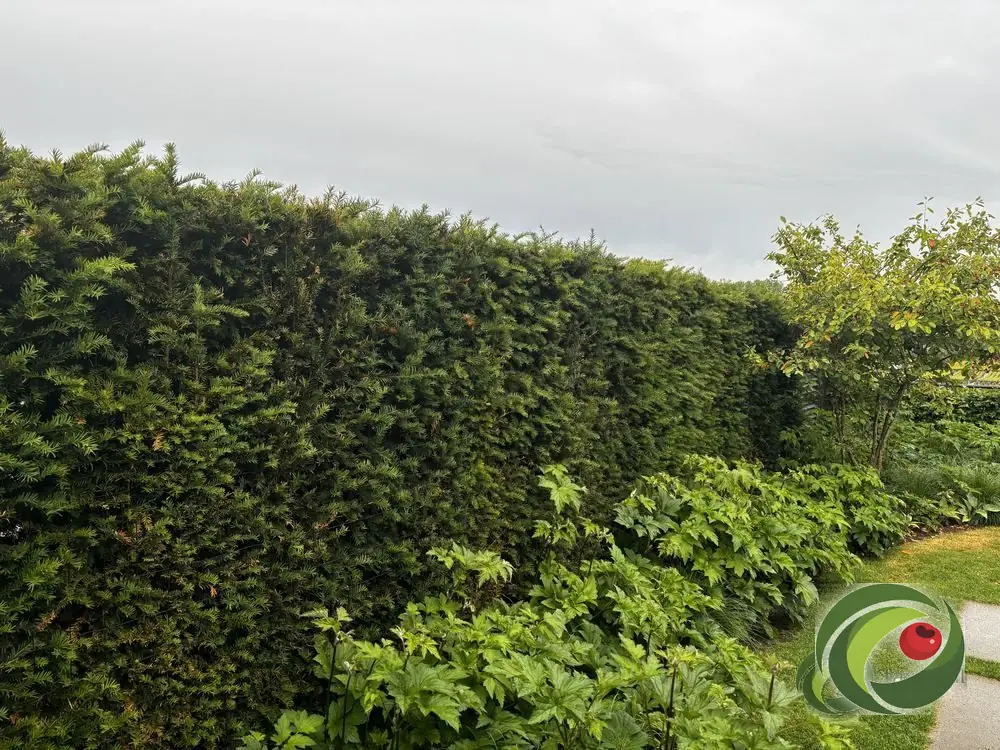
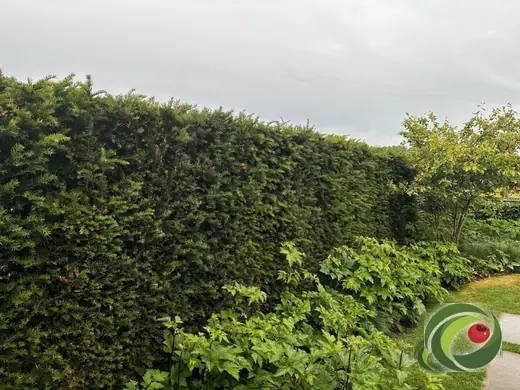
Dense, dark green yew hedge closed from top to bottom.
A mature yew hedge: dense and green all year, from top to bottom.
Short answerYes, but keep 30 to 40 cm distance and choose strong perennials that can cope with root competition.

Yes, but bear a few things in mind. Yew has a strong root system that takes a fair amount of moisture and feeding from the soil. Plants you set just in front of or behind a yew hedge have to be able to stand up to that. Strong perennials such as geraniums, hostas, hellebores and ornamental grasses do well. Plants with a weak or shallow root system have a harder time.

Also bear light in mind. The foot of a yew hedge is often shady, certainly on the north side. Choose shade plants there. On the sunny side you have more options.

TipDo not plant too close against the hedge. Keep at least 30 to 40 cm distance, so you can still get at the hedge to prune it without damaging the border plants.
↑ Back to contents
Short answerYew is a rewarding, undemanding plant, so the calendar is short. The broad line is simple. Planting and transplanting you do in the dormant season from autumn to early spring, pruning around the longest day in June, and feeding in early spring. In summer, water is the only thing to watch in drought. Below, season by season, what is going on.

This is roughly what the yew year looks like:

jan
feb
mar
apr
may
jun
jul
aug
sep
oct
nov
dec
Planting and transplanting
Pruning
Feeding
Watering in drought
Planting and transplantingPruningFeedingWatering in summer droughtWatering in a dry winter or spring, mainly young stock
  • Early spring, February to April. The start of the season. Feeding is allowed now, a layer of compost or mild organic fertiliser, never in autumn. Planting and transplanting can still be done as long as the plant is dormant and it is not freezing. Water new plantings in good time if it stays dry.
  • Late spring and summer, May to August. Pruning is best done around the longest day, late May to late June, once the first growth spurt is over. If you want a berry-free or tight hedge, trim again in July or August. Do not prune during a heatwave or in full sun. In dry, hot spells keep an eye on the watering, especially with young plants. And watch for nesting birds.
  • Autumn, September to November. The best planting season for field-grown yew. The soil is still warm and the plant has the whole winter and spring to root. After mid-September do not prune hard any more, because young growth freezes. A last light shaping in early September is still fine. You do not feed now.
  • Winter, December to February. Rest period. Planting and transplanting can still be done on a frost-free day, as long as the ground is not frozen. Otherwise you leave the hedge alone. Do not forget young stock entirely, because after a long, dry frosty spell without snow the soil can dry out. Then give a little water on a mild day.

This is the broad line. The details per job are in the separate questions, on pruning, feeding, watering, planting and transplanting. Remember mainly this. Plant and transplant in the dormant season, prune around the longest day, feed in spring, and water in a dry summer. Yew asks no more than that.

For what can come up in pests and problems through the year, see the chapter 'The yew calendar for pests and problems'.

TipPrune preferably before the longest day, around 21 June. After that the plant still makes nice new growth that comes out neatly, while a late pruning gives soft growth that comes through winter badly.
TipA handy rule of thumb. Plant when the leaves fall, prune when the days are longest. The rest follows by itself.
Short answerWith new plantings, water is the most important thing of all, more important than feeding. Water often and well in the first weeks, then taper off gradually. An established yew only needs water in drought. How much depends on the size of the plant, the soil type and the weather.

With a freshly planted yew, root-balled or bare-root, watering is the most important job in the first year. Most plants that do not make it die from too little water in the first months, not from frost and not from a lack of feed. Feeding only does something later on, water decides whether the plant takes. Whether and when to feed, you can read at the question 'Should I feed yew?'.

That holds for both plant forms, each for its own reason. A root ball is older and has more root mass, but the outer edge is cut away when it is lifted, so the plant has to root in again first. Bare-root stock is younger and smaller, and those exposed roots must not dry out after planting. Both therefore need a generous amount of water at the start.

If you plant in the wet dormant season, in autumn or winter, nature does much of the work and you water far less. The schedule below applies mainly to planting in the growing season and to dry, warm spells.

How often you water depends on the age of the plant and on the weather:

  • First two weeks. in dry or sunny weather, water every day. If it is cool or raining, check every other day and water only when the soil by the root ball feels dry.
  • Week three to about twelve. a good soaking two to three times a week. Better one good soaking than a little every day, as that sends the roots down to the depth.
  • After about three months. only in drought or heat. Keep checking through the first summer, even if the plant already seems to have taken.

An established yew, more than two years in the same spot, manages fine in normal years without extra water. In a dry summer you can safely give such an older plant a good soaking once too, certainly when the needles start to go dull.

How much water you give each time depends mainly on the size of the plant. For root-balled yew, use this guideline:

Root ball sizeWater per soaking
Small, up to 80 cm10 to 15 litres
Medium, 80 to 120 cm15 to 25 litres
Large, above 120 cm30 litres or more

For a hedge you reckon this up by the number of plants per linear metre. Take a small root ball at three plants per metre and 10 to 15 litres per plant, and you come to 30 to 45 litres per metre each time. If you plant bare-root or small stock close together, around five per metre, reckon on roughly 8 to 12 litres per linear metre each time. On sandy soil or in the heat you may be a little more generous everywhere.

In practice you do not need to measure this to the litre. A good garden watering can holds about 10 litres. For a small root ball, reckon on one to one and a half cans per plant, for a medium size one and a half to two and a half cans, and for a large root ball three cans or more. More important than the exact number is that the water really reaches the root ball and does not just wet the surface.

The soil type decides how often you water. Sandy soil drains quickly and holds little, so there you water more often and a touch more generously. Clay soil holds water for a long time, so there you water less often and watch that the plant does not end up sitting in a bathtub. How to deal with wet or poorly draining soil, you can read at the question 'My soil is wet or poorly draining, what should I do before I plant yew?'.

TipWater slowly. Tip a bucket out in one go and the water runs off alongside the root ball instead of into it. Give it time to sink in calmly, in two rounds if needed with a moment in between. A low rim of soil around the plant keeps the water above the roots and helps a great deal.
TipWater in the early morning or in the evening, not in the middle of the day. In full sun a large part evaporates before it sinks into the soil. In dry spells, spray the plants over the foliage now and then too. That freshens up the needles and washes off dust.
TipFeel whether the soil is still moist, and do not just check the top. Push your finger about ten centimetres into the soil, right beside the root ball. Dry means water, slightly moist is good, and soaking wet for days means you can ease off. The top can be bone dry while underneath it is still fine, and the other way around.

In some spots the soil dries out far faster than you think. Pay extra attention with:

  • sandy soil
  • a lot of wind
  • full sun
  • a spot under a canopy or roof overhang
  • plants close against a fence or paving
TipDo not forget young stock in winter. After a dry frosty spell without snow, or after a long dry spell in the winter months, the soil around young plants can dry out considerably. The plant stands there frozen and cannot take up moisture itself. Then give a modest splash at a frost-free moment. It need not be ten litres as in summer, a few litres per plant keeps the roots moist.
TipWe hear it often: "But we have a drip hose laid." Many domestic drip hoses give off too little water each time. In a hot summer that little bit has already evaporated in the top centimetres before it reaches the roots. A professionally set system that runs long enough works fine, but the average hose from the garden centre gives too little. Yew would rather have a good soaking once a week that penetrates to root depth than a thin trickle every day that only wets the surface.

The most common mistake is spraying a little every day. Then only the top layer stays wet, the roots do not go down, and at the first heatwave the plant goes under after all. But it can go the other way too. Yew hates wet feet. If the root ball stays soaking wet for weeks on end, it can start to rot. The soil should be moist, not a permanent mud bath. On clay soil that is the thing to watch, on sandy soil rarely.

Short answerTwice a year: late May/early June and late August/early September. Preferably no later than mid-September.

Prune yew twice a year. The first time late May/early June, the second time late August/early September. If you want to do topiary, balls or figures for example, you can give an extra light trim in between to keep the shape tight. Prune preferably no later than mid-September, and certainly do not cut back hard late in the season. In a mild autumn late September is still fine, but after that you run the risk of the yew shooting again. That young growth then no longer has enough time to harden off before the frost.

TipPrune in cloudy weather or in the evening, and not during a heatwave. Direct sunlight on freshly pruned needles can scorch them: the needles that were normally sheltered are not yet used to direct UV light. Also do not prune in frost: frozen branches are brittle and tear more easily, and the plant cannot recover while it is freezing.
TipUse sharp tools. Blunt shears tear the needles instead of cutting them cleanly, and that gives brown, ragged edges. For an ordinary hedge a sharp hedge trimmer (hand or electric) does the job. For topiary or smaller figures hand shears are more precise. Clean the shears after use, certainly if you have pruned diseased branches.
TipYew is one of the few conifers that comes back on old wood. Even if you prune drastically down to bare branches, it shoots again. That makes yew ideal for renovation pruning of neglected hedges.
TipIn spring and summer watch for nesting birds, because a yew hedge is a favourite nesting spot. The breeding season runs roughly from mid-March to mid-July, though no bird sticks exactly to the calendar. It is not the pruning itself that is forbidden, but disturbing an occupied nest, and there is a duty of care for that under the Environment and Planning Act. So check first whether there is a nest in it. If there is, leave that section alone until the young have fledged. If you want to trim without worry, do it outside that period.
Short answerFor an ordinary yew hedge a sharp hedge trimmer is the main thing, by hand or electric. For balls, cones and smaller shaping you take hand shears, they prune more precisely. The golden rule is that it has to be sharp. Blunt shears tear the needles instead of cutting them cleanly, and that gives ugly brown edges.
Sharp matters more than expensive. Whatever you choose, it has to be sharp. Blunt shears do not cut the needles but tear them apart, and those ragged edges turn brown. Cheap but sharp shears give a nicer result than an expensive blunt pair. So sharpen or replace in good time.

The common types in a row:

  • Hand hedge shears. two long blades, hand-operated. Lots of control, nice and quiet, fine for a short hedge. For a long hedge it becomes heavy work for your arms.
  • Electric or cordless hedge trimmer. for a somewhat longer hedge this saves a lot of time and effort. A cordless trimmer is light and without a cable, mains power is stronger but you drag a cable along. For an average garden hedge usually the best choice.
  • Hand shears. for topiary, balls, cones and spirals. You work more slowly but far more precisely. Bypass shears, with blades that slide past each other, cut more cleanly than anvil shears and are the better choice for living green.
  • Telescopic or pole shears. for a tall hedge or tall shape an extension pole saves you climbing the ladder. A little less control, but safer for the high work.
  • Loppers or secateurs. for the odd branch that is too thick for the hedge trimmer.
TipLay a sheet or cloth under the hedge, then you clear up the poisonous prunings in one go. What else to do with the prunings, you can read under the question 'What do I do with yew prunings?'
TipHow to clean, disinfect and keep your tools rust-free, you can read under the question 'What do I use to clean and disinfect my pruning tools?'. And watch the weather, do not prune in frost or in full sun. Why, and when you do prune, you can read in the question about pruning.
TipTorn between bypass and anvil shears? With a bypass, two curved blades slide past each other, just like ordinary scissors, and that gives a clean, flat cut. With anvil shears a blade comes down on a flat plate, the anvil, and the branch is cut against it, more crushed than cut. For living green like yew, bypass is the better choice, because a clean cut heals faster. Keep anvil shears for dead, dry or hard wood.
TipFor the electric work we like to use Stihl in the nursery ourselves. Powerful, reliable and they last for years. That is no rule, because in the end it is about sharp and well-maintained tools, not about the brand. But if you do choose an electric or cordless trimmer, you know where our preference lies.
TipFor an ordinary garden with not too much hedge you do not need to look in the expensive range straight away. The Parkside garden tools from Lidl do the job fine for that work, certainly if you only prune a few times a year. If you pay for a professional machine, you mainly pay for intensive, daily use.
TipAnd no, we are not sponsored. We have used these tools to our full satisfaction for years.
Short answerCleaning and disinfecting are two things. Cleaning is getting the dirt, sap and sticky resin off, disinfecting is killing disease germs so you do not spread them from one plant to another. For the first, warm water and a little soap are enough, for the second you take alcohol or a diluted bleach solution. Dry the tools well afterwards, that prevents rust.

Start with cleaning. After a pruning there is plant sap, dirt and, with yew, often sticky resin on the blades. Wipe the coarse stuff off and wash the blades with warm water and a little washing-up liquid. Stubborn resin comes loose with a cloth and some white spirit or turpentine. Rinse afterwards and dry the blades well.

Disinfecting you do separately, and especially if you have cut into diseased or affected wood. Wipe the clean blades with alcohol of about 70 percent, sold as surgical spirit or methylated spirit. That works fast and evaporates without leaving much behind. A diluted bleach solution can also be used, but bleach attacks the metal, so rinse and dry straight afterwards. If you have cut away diseased branches, disinfect in between too, not only at the end.

Finally, the maintenance. Dry tools do not rust, so never put them away wet. Rub the blades now and then with a thin film of machine oil or vegetable oil against rust and to keep cutting smoothly. And keep them sharp. Sharp shears make a clean cut, and a clean cut heals faster and is less prone to disease than a ragged one.

TipFor the ordinary, healthy hedge you do not need to disinfect at every cut. That matters mainly with diseased wood and when you go from one plant to another. Cleaning and drying afterwards is always worthwhile, then your tools last years longer.
TipRead the manual of your own tools too. Especially with an electric or cordless trimmer there are particular rules. Think of which part may and may not get wet, which oil to use, and how to release the blade for cleaning. What the maker prescribes always takes precedence.
Short answerYes, ideally suited. Balls, cones, spirals: yew can do it all. Two to three trims a year.

Absolutely, and yew is even ideally suited to it. The fine, dense branching and the slow, even growth pattern make yew ideal for balls, cones, spirals and other shapes. You see it in castle gardens and country houses, but it works just as well in an ordinary garden. Start with a young plant and prune into the shape you want from the start. The earlier you begin guiding it, the nicer and tighter the result.

TipTopiary calls for two to three trims a year to keep the shape tight. Use sharp hedge shears or hand shears, depending on the size of the figure. For complex shapes a wire frame can help as a template, certainly at the start.
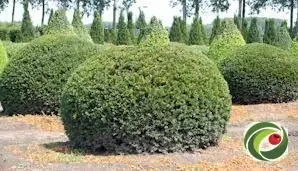
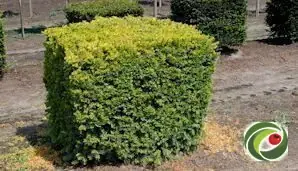
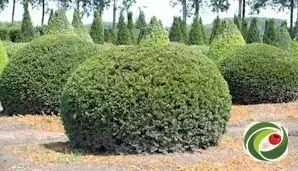
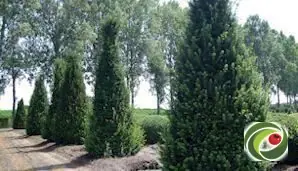
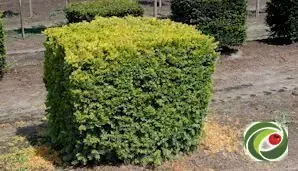
Yew clipped into a ball at the nursery.Yew clipped into a cone at the nursery.Yew clipped into a block at the nursery.
Our own topiary at the nursery: ball, cone and block. With its fine needles, yew clips tightly into almost any shape.
Short answerThe hedge slowly goes broad, loose in structure and bare at the bottom. Always still recoverable, because yew shoots again on old wood.

If you do not prune a yew hedge, it grows slowly but steadily into a broad, loose structure. After a few years the hedge becomes full and broad at the top, but ever barer at the bottom because the inside gets too little light. You are then left with a hedge that is green on the outside but hollow and brown inside. As a solitary tree or freely growing shrub that is no problem, but for a tight, dense hedge regular pruning is necessary.

TipHave you not pruned for a few years and the hedge has lost its shape? No panic. Yew is one of the few conifers you can cut back hard, even down to bare wood. It shoots again. Do that in early spring, though, and not everything at once.
Short answerUsually little. Yew is not a demanding plant. You feed in spring, never in autumn. What is needed depends on the soil type and on what you already gave it when planting.

Yew does not get better from a lot of fertiliser. Once the hedge is well established, an annual layer of compost is often enough, or at most some light organic fertiliser in spring. Then choose something mild, such as dried cow manure pellets or a yew or conifer fertiliser. Sharp fertiliser like fresh chicken manure gives too much nitrogen and can scorch young roots. You feed from late winter until the new growth starts. Autumn feeding is out of the question. If you do it anyway, the plant still makes young, soft growth, and that freezes in winter.

The soil determines a lot. On sand, feeding washes out fast, so a little extra feeding in spring is more worthwhile there. On clay or loam the problem is rarely feeding but air and drainage. Put the emphasis there on structure and drainage.

Did the plant already get compost or fertilised garden soil when planting? Then extra fertiliser at the start is usually not needed. Do not overdo nitrogen. That gives soft, sappy foliage that is more prone to frost and disease.

TipSee feeding as the last step, not the first. A yew in wet or compacted soil does not perk up from more granules.
TipCompost is the best all-round soil improver for yew. A layer of 2 to 3 cm around the plant in spring does more than any artificial fertiliser.
TipMagnesium fertiliser (kieserite) can make a difference on sandy soil. Magnesium makes chlorophyll and gives the deep green colour. A shortage gives dull or brownish needles, and on sand magnesium washes out faster. If you see that, it helps to scatter some kieserite in early spring. Do look at drainage, structure and ordinary feeding first: kieserite is a supplement, not a miracle cure. For the dosage, check the packaging. On clay or loam it is fine too. There it is just less often needed.
TipLime and kieserite work against each other a little: lime slows the uptake of magnesium. Liming, by the way, does not have to be done every year as standard, only if your soil is more acidic than about pH 5. If you do have to lime, do it in February and wait about four weeks before you give kieserite and fertiliser.
Short answerYew does not need much, so with fertiliser you do not have to be lavish. Broadly speaking there are two families. Organic fertiliser, such as compost and cow manure pellets, works slowly and feeds the soil. Artificial fertiliser, in granules or liquid, works fast but does nothing for the soil. For yew, organic is almost always the better choice. You feed in spring, never in autumn.

One thing first, because it saves money. Yew does not get better from a lot of fertiliser. An annual layer of compost is enough for most hedges. See fertiliser as a supplement on poor soil, not as standard fare. And never overdo nitrogen, because that gives soft, sappy foliage that is prone to frost and disease. How often and how much, you can read under the question 'Should I feed yew?'.

Organic fertiliser comes from plant or animal material. It works slowly, because the soil life has to break it down first, and that is exactly what feeds the soil and improves the structure. For yew this is the nicest group. The common types:

Organic fertiliserWhat it isFor yew
CompostDecomposed organic material, not a strong fertiliserThe best all-round choice. A layer of 2 to 3 centimetres in spring does more than any granule
Dried cow manure pelletsMild, complete fertiliser that releases slowlyFine, not too sharp
Farmyard manureRicher and coarserUse only well-rotted, because fresh farmyard manure is too sharp and can scorch roots
Blood meal, hoof and horn meal and feather mealGround by-products from the abattoir (dried blood, horn and hooves, feathers), rich in nitrogenPossible, but not needed for most hedges. Blood meal works fast, hoof and horn and feather meal slowly

Fresh chicken manure you leave alone. It is packed with nitrogen and too sharp for young roots.

Artificial fertiliser, also called mineral fertiliser, gives the feeding in direct form, without the soil life being involved. It works fast, but does nothing for the structure of your soil. On the bag you often see three numbers, the NPK value. Nitrogen (N) is for foliage and growth, phosphorus (P) for the roots, potassium (K) for sturdiness. For yew you rarely need artificial fertiliser. If you do want to use it, choose a slow-release granule and go easy on the nitrogen.

There are also targeted products. A yew or conifer fertiliser is a ready-made granule tuned to conifers, safely dosed and handy. Kieserite is not ordinary feeding but pure magnesium, which helps with dull or brownish needles on sandy soil. And lime is not feeding but something to raise the acidity, which yew rarely needs. About kieserite and lime you can read more under the questions 'Should I feed yew?' and 'Does yew need lime, and does it like acidic soil?'.

Finally the difference between granule and liquid. Granular fertiliser works gradually and is usually handiest for a hedge in open ground, you scatter and that is it. Liquid fertiliser works faster but is short-lived, and is mainly practical for plants in a pot. For yew in the garden you keep to granules or simply compost.

TipFeed from late winter until the new growth starts, so roughly February to April. Autumn feeding is out of the question, because then the plant still makes young, soft growth, and that freezes in winter. If you planted in autumn, give no fertiliser that season and only judge the spring after whether feeding is needed.
TipThink of the order. First drainage and structure, then water, and only after that feeding. A yew in wet or compacted soil does not perk up from more granules.
TipIf you scatter granules, water straight away. They only dissolve and reach the roots when the soil is moist, so on dry or frozen ground they are pointless and the feeding washes away sooner. With a layer of compost this does not apply, that works along with the rain by itself.
Short answerNot in the planting season itself. Improve the soil with compost or unfertilised garden soil and only judge the spring after whether light feeding is needed.

If you plant in autumn, you want the roots to establish quietly in cool, moist soil. So no fertilised garden soil and no extra fertiliser. Work compost or unfertilised garden soil through the soil. In spring you see how the hedge comes out. If it stands fresh green, feeding is often not needed. Only on poor sandy soil or with visibly slow growth is some extra feeding in spring worthwhile.

Short answerLightly, and only if it is needed. On poor soil some extra feeding in spring can help. If you already worked in compost or fertilised garden soil, extra fertiliser is usually superfluous.

With spring planting the plant goes straight into the growing season, so you may feed lightly. Do it with judgement. Only on poor or visibly weak soil, and with an ordinary organic fertiliser, not heavy on nitrogen. If enough compost is already worked in, the plant has enough for now. Fertilised garden soil never pure, and do not push it. A quiet start with good soil and water works better than a lot of fertiliser.

Short answerNot compulsory, but smart. Keeps the soil moist, cool and weed-free.

Mulching is covering the bare soil around the plant with a layer of organic material, for example bark, wood chips or cocoa shells. It is not compulsory, but it is smart. Such a layer of 5 to 8 cm keeps the soil moist, suppresses weeds and buffers temperature swings. Especially with young plantings and on dry sandy soil, mulch makes a big difference.

TipKeep the mulch a few centimetres away from the stem. Direct contact between mulch and stem can encourage fungus. And do not lay the layer too thick, more than 10 cm smothers the roots and actually encourages rot.
Short answerClear them up straight away, do not leave them lying. Poisonous to animals, even when dried. May go with the green waste.

Yew prunings are poisonous and must not be left lying in places where children or animals can get at them. Dried needles are at least as poisonous as fresh ones, so even on the compost heap it is a risk if pets or livestock come near. In most councils the prunings may go with the green waste or to the recycling centre. Not sure? Get in touch with your council.

Perhaps you have heard that you could hand in yew prunings for the making of cancer medicine. That was true for years, because the needles of Taxus baccata contain a raw material for chemotherapy. That collection stopped in 2025. For the medicines a different yew species is now used that does not grow here and contains much more active substance. So you no longer have to keep your prunings aside for it.

TipRake the prunings together straight away and clear them up. Do not leave them lying for a few days "because they still have to dry anyway". Certainly with horses and other farm animals that is a real risk.
Short answerAn established yew is surprisingly tough. New plantings are vulnerable and need extra water.

An established yew (more than two years in the same spot) is tougher than most people think. Yew occurs naturally on dry woodland edges and on limestone rocks, and can take quite a lot. But in prolonged heat and drought, as we see more and more often in recent years, even a mature yew can become stressed. Watch for the early signs. The needles go dull and lose their shine, young shoots feel limp, and the green takes on a slightly greyish haze. If you step in with water then, you prevent the needles from turning brown.

With new plantings it is a different story. Young plants have no deep root system yet and are completely dependent on water that you give. Certainly in hot summers that is the difference between establishing and dying.

A factor that is often underestimated is wind. Biting or persistent wind dries out the needles, even if the soil seems moist enough. In winter that is extra treacherous. The ground is frozen, the roots cannot take up moisture, but the wind does draw moisture from the needles. If your yew stands on an exposed spot, bear that in mind when watering and consider a windbreak in the first years.

TipMulch is your best friend in drought. A layer of 5 to 8 cm of bark around the plant keeps the soil cool and moist, even when it does not rain for weeks. Combine that with a good soaking once a week instead of a little every day.
↑ Back to contents
Short answerOn average 15 to 25 cm a year. Slower than many hedging plants, but compact as a result and needing little pruning.

The growth rate of yew is on average 15 to 25 cm a year, depending on the position, soil type and care. That is slower than many other hedging plants, but the advantage is that a yew hedge grows compact and dense and needs less pruning to stay in shape.

TipWant a dense hedge faster? Then choose larger starting sizes instead of hoping that small plants will grow faster with extra feeding. Yew will not be hurried.
TipYew roots relatively shallow and wide, usually in the top 40 to 60 cm of the soil. As a result yew rarely causes problems with pipes or foundations, but it does compete with plants standing right beside it. Yew does not sucker or run wild: it stays neatly in its place.
Short answerMore than a thousand years. In a garden a yew hedge lasts for generations.

Yew is one of the longest-living trees in Europe. There are specimens in England and Wales estimated at more than a thousand years old. In an average garden a yew hedge will last for generations. It is literally an investment for life.

Large, free-grown yew several decades old in a field.
A free-grown yew, decades old. Let it do its thing and it becomes this large and dense on its own.
Short answerAs tall as you want. Usually 1 to 2.5 metres, but even 3 to 4 metres is manageable.

In theory Taxus baccata can grow into a tree of 15 metres or more. As a hedge, yew is usually kept at 1 to 2.5 metres, but you can prune it to any height you want. Even hedges of 3 to 4 metres are easily manageable.

Short answerYes, yew can be kept at 30 cm wide. Ideal for narrow gardens and paths.

A yew hedge can be kept at almost any width, which is one of the big advantages over laurel or conifer, for example. A common width is 40 to 60 cm, but you can also keep yew at 30 cm wide if you prune consistently. That makes yew ideally suited to narrow gardens, paths and spots where you do not want to lose a centimetre.

If you let a yew hedge grow completely freely, it gets broader by itself. A mature, unpruned specimen can easily reach one and a half metres wide. But that is rarely the intention with a hedge. With two trims a year you keep it exactly as narrow as you want.

TipPrune the hedge a little narrower at the top than at the bottom (a slight A-shape). That way the bottom gets enough light too and the hedge stays dense and green from top to bottom.
Short answerNo. Yew is evergreen and keeps its needles all year round.

No. Yew is evergreen and keeps its needles all year round. That is exactly what makes yew so suitable as a hedging plant. You have privacy and a green look in winter too. Yew does shed some of its older needles on the inside of the plant in autumn. These go yellow and fall. That is normal and part of the natural renewal of the foliage.

It is normal, though, for yew to look a little different in winter than in summer. The colour often goes a bit duller and darker, and the green can turn slightly brownish or bronze. That is not a disease but a natural reaction to cold and short daylight. As soon as spring begins and the temperature rises, the colour comes back by itself.

Close-up of the flat, dark green needles of yew.
The flat, dark green needles stay on all year.
Short answerNot until April or May, later than most plants. No panic if the rest of the garden is already green.

Yew is a late starter. Where many other plants come into leaf in March or April, yew only starts making new shoots somewhere in April or May, depending on the weather and the position. That new growth is recognisable by the light green, soft needle tips at the ends of the branches.

Many people take fright in early spring because their yew still looks exactly as it did in winter, while the rest of the garden is already going green. That is normal. As long as the needles are dark green and firm, there is nothing wrong. Yew simply takes its time.

TipWorried whether a yew is still alive after winter? Scratch a twig with your nail. If the wood underneath is green, the plant is alive and the new growth will come by itself.
Yew with light green spring growth against dark green older foliage.
The light green spring growth stands out freshly against the dark, older foliage.
Short answerBare-root stock: three to four years. Large root-balled plants: one to two seasons. Larger starting sizes often in the first year.

That depends on the starting size and the planting distance. With small bare-root stock (20 to 50 cm) at 5 plants per metre it takes about three to four years before the hedge is really dense. With larger root-balled plants (60 to 100 cm) at 3 plants per metre you can have a closed hedge within one to two seasons. Larger starting sizes of a metre or more often close up in the first growing season.

TipTrim your young hedge lightly at the sides in the first years, even if it has not reached the width you want. That encourages branching and makes the hedge dense from the bottom up. Anyone who waits too long with the first trim gets a hedge that is full at the top but stays bare at the bottom.
Short answerYou can, but it takes years and not every cutting takes. Professionally grown from open ground is a far better start.

You can, but it is a long-haul business. Yew cuttings root slowly, often only after six to twelve months, and not every cutting takes. After rooting it still takes years before you have a plant big enough for a hedge. Professionally grown yew from open ground has a head start of years and a root system that is far better developed.

TipStill want to try? In autumn take semi-ripe cuttings of 15 to 20 cm, remove the lower needles and put them in a mix of sharp sand and potting compost. Keep them frost-free and moist. Patience is the key word.
↑ Back to contents
Short answerYew is the most versatile of all hedging plants. It is evergreen, can be low or high, shoots again on old wood and lasts longest. In the table below you see at a glance how yew compares with the other commonly used hedging plants.

Below are the most used hedging plants alongside yew, on the points a choice usually comes down to.

PlantEvergreenHeightGrowthPruningOld woodPoisonous
YewYesLow to highSlow1xYesYes
BoxYesLowSlow2xYesYes
LaurelYesHighFast2xYesYes
HornbeamNoHighFast1 to 2xReasonableNo
BeechNoHighFast1 to 2xLimitedNo
HollyYesLow to highSlow1 to 2xYesSlightly
PrivetSemiHighFast2 to 3xYesYes
Conifer (thuja, leylandii)YesHighFast2 to 3xNoYes
Lonicera nitidaYesLowFast2 to 3xYesNo
Ilex crenataYesLowSlow1 to 2xYesSlightly

Hornbeam and beech hold dead brown leaves in winter. They are not evergreen, but not bare either.

TipWant to weigh up two plants side by side properly? Below this table you will find a detailed comparison with yew per plant.
Short answerAbsolutely. Evergreen, compact, no trouble from box tree moth or box blight. More durable and lower-maintenance.

Absolutely. Since box tree moth and box blight have been destroying more and more box hedges, many garden owners are switching to yew. Like box, yew is evergreen, excellent for topiary and grows compact and dense. The big difference is that yew has no trouble from box tree moth or box blight and so is a lower-maintenance and more durable alternative.

TipYew grows a little faster than box and can also stand in spots in deep shade where box struggles. For low hedges and borders, Taxus baccata is an excellent replacement.
Short answerYew grows more compact, is very hardy, easier to prune and lasts longer. Laurel grows faster but is more sensitive to frost and soon gets too broad.

Many people hesitate between yew and cherry laurel (Prunus laurocerasus). Below you see them side by side.

FeatureYewLaurel
Growth rateSlower, but compact and denseFast, you have a dense hedge quickly
WidthSlim, takes little spaceSoon gets broad and has to be cut back hard regularly
PruningNeat with the hedge trimmer, without ugly leaf damageLarge leaves go brown under the hedge trimmer, so hand shears needed and more work
HardinessVery hardyMore sensitive to severe frost, especially the variety 'Rotundifolia'
LifespanLasts longer, generations with good careShorter

For a slim, tight hedge that takes little space, yew is the better choice. If you want a broad, green wall quickly and the width does not matter, laurel can be an option.

Short answerYew is green all year, ideal for tight shapes and gives little clearing up. Hornbeam and beech grow faster, but hold brown leaves in winter that you have to clear in spring. Want a green screen year-round, choose yew. Want height fast, look at hornbeam or beech.

The biggest difference is in the foliage through the year. Yew is evergreen and keeps its green needles all year, in winter too. Hornbeam and beech lose their leaves, but often hold the withered brown foliage all winter, certainly as a young or pruned hedge. Only when the new leaves come out in spring does the old fall off. That fallen leaf then has to be cleared up. With yew you do not have that spring leaf fall.

Hornbeam and beech are often confused, but they are two different plants. Hornbeam belongs to the birch family, beech is a true beech. Both exist in a green and a copper form, and copper hornbeam colours red-brown from the start. You recognise them by the leaf. That of hornbeam is smaller, slightly toothed and wrinkled. That of beech is larger, smoother and has a glossy edge.

Hornbeam and beech grow faster and are therefore at height sooner. Yew grows more slowly, but steadily and densely. If you are in a hurry for a tall screen, you are often finished sooner with hornbeam or beech. If you want a tight, fine hedge that you keep in shape for years, yew is the one.

Soil and moisture play a part too, and the three differ considerably there. Hornbeam is the most versatile. It tolerates heavier and wetter soil best of the three, and can cope reasonably well with drier spells too. Yew and beech both want well-draining soil and have little use for wet feet, each for their own reason. With yew it is the risk of root rot, with beech the shallow root system that copes badly with oxygen-poor, wet soil. With drought it is different. Yew holds out best then. Beech is the most sensitive, with brown leaf edges and early leaf loss, and is under pressure in the drier summers of recent years.

Pruning is part of all three. A hedge only stays tight if you prune it regularly, whether that is yew, hornbeam or beech. The difference is in cutting back hard on bare old wood. Yew reshoots there most reliably. Hornbeam does so reasonably too, but less predictably. Beech reshoots badly on bare old wood. Bear in mind too that yew is strongly poisonous, certainly to horses and livestock. Hornbeam and beech do not pose that danger.

Finally, the lifespan. Yew can become hundreds of years old, and in Europe there are yews of more than a thousand years. Beech and hornbeam do not get nearly that old. As a hedge they are fine for a human lifetime, but a yew hedge can last for generations.

TipIn your choice, look mainly at what you want to see all year and how much maintenance you want. A green screen in winter with little clearing up means yew. Height fast, with brown winter foliage and some clearing up in spring, means hornbeam or beech.
Short answerBoth are green all year. Yew has soft needles and prunes into a fine, tight hedge. Holly has hard, prickly foliage and is strong precisely as an impenetrable hedge, with red berries for ornamental value. Want a tight, touch-friendly hedge, choose yew. Want a prickly barrier with berries, then holly is worth considering.

Unlike hornbeam and beech, yew and holly are both evergreen. They keep their foliage all year, so you have a green screen winter and summer and no brown winter leaf to clear in spring.

The biggest difference is in the foliage. Yew has soft, fine needles you can walk right past. Holly has hard, glossy foliage that is prickly in most hedging types. That makes holly less pleasant along a path or play area, but strong precisely as an impenetrable, intruder-resistant hedge. A yew hedge is nice where people come close, a holly hedge keeps people and animals at a distance.

Pruning is possible with both, but the result differs. With its fine needles, yew gives the tightest, most even cut surface and is the plant for topiary. With holly the larger leaves are partly cut through by the hedge trimmer, which looks a little messy for a while with brown cut edges. If you want holly really tight, you work with hand shears rather than a hedge trimmer. Prune holly preferably in late spring, just before the new growth hardens, then the cut edges show less.

Holly is known for its red berries, a fine winter ornamental value and loved by birds. Those berries only come on female plants, and then only if there is a male holly nearby. Yew also has red berries on female plants. What exactly those are, you can read under the question 'What are those red berries on my yew?'. Bear in mind that the berries and seeds of both are poisonous, in yew more strongly than in holly.

If you want holly as a hedge, blue holly is a much-requested choice, the Ilex meserveae 'Blue Prince' and 'Blue Princess'. These are extra hardy and have blue-green, glossy foliage. The 'Blue Princess' bears red berries, but only if there is a 'Blue Prince' nearby to pollinate. In terms of position, yew and holly are alike. Both can be in sun and partial shade, and both want well-draining soil without wet feet.

TipLook at the function of your hedge. For a fine, tight and touch-friendly hedge, yew is the classic. Want a prickly, impenetrable hedge with red berries for the birds, then holly, and certainly blue holly, is worth considering.
Short answerPrivet grows extremely fast and is cheap, but loses its foliage in cold winters and needs frequent pruning. Yew is green all year, stays tight with little pruning and lasts far longer. Want a hedge fast and cheap, privet is an option. Want year-round green and little maintenance in the long run, choose yew.

Yew is green all year. Privet is semi-evergreen. In a mild winter privet keeps most of its foliage, but in a cold winter it drops a fair amount. For a screen that stays dense and green in winter too, yew is more reliable.

Privet is one of the fastest hedging plants there is, and cheap. You have a green wall with it quickly. Yew grows more slowly and is dearer, but you get that back in years of calm and a hedge that stays tight.

It is precisely that fast growth that makes privet need more maintenance. If you do not prune it two to three times a year, it soon goes thin and bare at the bottom. Yew grows more calmly and often stays neat and dense with one trim a year. So in the long run yew is the less laborious of the two.

Privet is otherwise not fussy and copes with almost any soil, in the city too. Privet does have strong, greedy roots that take water and feeding from the plants beside it. Yew wants well-draining soil without wet feet, but leaves the border around it more in peace.

A difference you do not always expect is the flowering. Privet flowers in June and July with white panicles that are strongly scented. One person finds that lovely, another too heavy, and for some people that scent is a reason not to take privet. Yew has no conspicuous flowering and no scent.

Bear in mind that both are poisonous, yew in all parts except the red flesh, privet in the foliage and black berries. Those black berries are poisonous to people, but birds eat them readily. And where a privet hedge lasts a few decades, a yew hedge can last for generations.

TipChoose on the basis of budget and patience. If you need a hedge fast and cheap and do not mind regular pruning, privet is fine. Want year-round green, little pruning and a hedge that lasts, then yew is the nicer choice in the long run.
Short answerConifers like thuja and leylandii grow extremely fast into a green wall, but you cannot cut them back hard, because they no longer reshoot on bare wood. Yew grows more calmly, stays fine and tight, and does reshoot on old wood. Want height fast and keep it tight, a conifer can do it. Want a hedge you can steer and that lasts, choose yew.

Like yew, thuja and leylandii are green all year. The big difference is in what happens when you cut them back.

Yew reshoots on old, bare wood. If you cut back too far, or a section has gone bare, it usually just fills in again. With thuja and leylandii that is not possible. If you cut into the bare, brown wood, that spot stays bare. A conifer that is bare at the bottom or inside, you will not get green again. That is why yew is far more forgiving and you can still bring it back into shape after years.

Leylandii is one of the very fastest hedging plants and gets extremely tall and broad without tight upkeep. Many neighbour disputes over too-tall hedges are about leylandii. Thuja also grows hard. Conifers like leylandii moreover have greedy, shallow roots that suck up a lot of water and feeding from the plants beside them. Yew grows more slowly and so stays more manageable for a neat, measured hedge.

There are also more slowly growing thujas, such as the Thuja occidentalis 'Smaragd', popular as a neat hedge. These are easier to manage, but they too do not reshoot on bare wood, so the drawback when cutting back hard remains.

Conifers can discolour unattractively. Thuja often turns bronze to brown in winter, and with drought or disease bare brown patches appear that no longer recover. Yew stays deep green all year and does recover.

Bear in mind that yew is strongly poisonous. Thuja too contains a poisonous substance, thujone, although it is less acutely dangerous than yew. And where a conifer hedge usually lasts a few decades and then has to be replaced, a yew hedge can last for generations.

TipWant a tall green wall fast and willing to shear it tight two to three times a year, then a conifer can do it. Want a hedge you can keep in shape, that does not stay bare after a trim and that lasts, then yew is the safer choice.
Short answerFor a low hedge, in the front garden for example, Lonicera nitida is fine, and it grows faster and cheaper than yew. But it stays low, usually 1 to 1.5 metres and rarely higher than 2 metres. Yew you can keep just as low, but also raise to 3, 4 metres or higher. Want height, or want to be free in the height, then yew is the choice.

The biggest difference is the height. Lonicera nitida stays low by nature and rarely gets higher than two metres, even if you do not prune it. That makes it a nice plant for a low hedge, in the front garden for example. But it goes no further than that. Yew you can keep just as low for such a front-garden hedge, and at the same time raise to three, four metres or higher for a sturdy privacy hedge. Few hedging plants can do both. That versatility is one of yew's strong points.

For a low hedge, Lonicera nitida is a fine option. It has small, dark green foliage, grows fast and is cheap, and is often offered in garden centres as an alternative to box.

On two points Lonicera nitida actually scores a little more widely than yew. It grows on almost any soil type, from sand to clay and peat, as long as no water stands. Yew is a little fussier there, certainly on heavy, wet clay. And Lonicera nitida tolerates shade a little better still than yew. For a dark spot, along a north wall or under trees for example, it is even slightly more suitable.

In pruning they are more alike than you would think. Both reshoot on old wood, so you can cut both back hard and they come back. The difference is in the rhythm. Lonicera nitida grows so fast that you have to cut it two to three times a year to keep it tight, and it soon falls open untidily, certainly under a load of snow. Yew keeps its shape far longer and is often neat with one trim a year.

In terms of diseases and pests, both are fairly healthy. Yew is remarkably robust as long as the soil drains well, with root rot in wet soil as the main weakness. With Lonicera nitida the weak point is not so much disease, but that it can go bare and untidy at the bottom and is then hard to get nicely dense again. Aphids can occur and cause curling leaf tips, but are rarely a serious problem.

That falling open also has to do with the lifespan. A clipped hedge of Lonicera nitida often goes untidy after ten to fifteen years and is then replaced. A yew hedge can last fifty or a hundred years and actually gets sturdier and finer over the years. Want to plant once and then have a tight hedge for decades, then yew is the choice.

Another difference. Yew is poisonous, Lonicera nitida is not. For a garden with animals or young children that can weigh in.

TipTorn between the two? If you only want a low hedge, Lonicera nitida is fine. Want higher, or the same hedging plant at different heights in the garden, then yew is the more versatile and durable choice.
Short answerBoth are sold as a replacement for box. Ilex crenata, with its small leaf, looks most like box and is ideal for a low, tight hedge or balls. Yew can do that too, but also grows on into a tall hedge and is less fussy about the soil. Want purely the box look in miniature, then Ilex crenata comes closest. Want versatility and a plant that establishes anywhere, then yew is the surer choice.

Ilex crenata, the Japanese holly, has small, glossy foliage that strongly resembles box. That makes it the best-known box replacement for a low, tight hedge, balls or topiary. But like box, Ilex crenata stays low. For a tall hedge or boundary it is not the plant. Yew you can keep just as low and tight, and at the same time raise into a tall hedge. That whole range from low to high you get with yew from one plant. Whether yew itself is a good box replacement, you can read under the question 'Is yew a good alternative to box?'.

On soil, yew is the easier of the two. Yew tolerates many soil types, calcareous too, as long as it is not too wet. Ilex crenata is fussier. It wants well-draining, rather acidic and humus-rich soil, and dislikes lime and wet feet. On the wrong soil it goes yellow or gets root problems. Watch out for a pitfall here. Box actually likes lime, Ilex crenata does not. If you plant Ilex crenata in the old box soil without improving it well first, it can do badly there.

Both prune and keep their shape well, and both reshoot on old wood. Ilex crenata grows slowly, like box, and so stays nicely compact. Yew also grows calmly and keeps its shape long.

From our own experience we know that a young Ilex crenata often stands still for a few years after planting before it gets going, and that it is sensitive to severe frost. Yew is clearly hardier and usually also gets going faster after planting.

Another difference. Yew is strongly poisonous, and the berries of Ilex crenata are slightly poisonous. For a garden with animals or young children that can weigh in.

TipWant exactly the box look back, small and tight, on good soil? Then Ilex crenata is the nearest replacement. Want a box replacement that can also go higher, grows on almost any soil and asks for hardly any attention, then yew is the safer choice.
Short answerYes. There are yellow-green, golden and columnar variants, but these grow more slowly.

Yes. Taxus baccata 'Semperaurea' has yellow-green foliage and gives a lighter accent in the garden. Taxus baccata 'Fastigiata Robusta' grows columnar with dark green foliage. There are also forms with golden-yellow needle tips, such as 'Elegantissima'. These coloured forms usually grow a little more slowly than ordinary green yew.

Short answerBaccata grows more compact and dense, ideal for hedges. Media grows looser and broader. We supply baccata.

Taxus baccata is the native European yew, which occurs here naturally and has been used for hedges and topiary for centuries. Taxus media is a cross between Taxus baccata and the Japanese Taxus cuspidata. The difference is mainly in the growth habit.

FeatureTaxus baccataTaxus media
OriginNative European yew, occurs here naturallyCross between Taxus baccata and the Japanese Taxus cuspidata
Growth habitCompact and denseBroader and looser
NeedlesShorter, forms a dense hedgeLonger needles
Suitable for a tight hedgeIdealLess suitable

We supply Taxus baccata, because for hedging purposes in the Dutch climate it is simply the best choice.

TipSee "yew" offered somewhere without a species name? Then always ask which species it is. The difference in growth habit and end result is bigger than you think.
Short answerFewer than you would think. Botanists differ on it, but it is about nine to twelve true species worldwide, spread over Europe, Asia and North America. That dozens of names come past in the shop is because they are largely cultivars, selections of a few species, not separate species. We supply Taxus baccata, the only one that belongs here naturally.

Botanists do not agree on the exact number. Most settle on about nine species, a much-used list comes to ten or twelve, and one researcher even counted twenty-four. The problem is that the species closely resemble one another and are told apart mainly by their origin. In the past they were therefore sometimes seen as subspecies of one yew.

The best-known species in a row:

  • Taxus baccata. the common or European yew, native to Europe as far as North Africa and West Asia. This is ours.
  • Taxus cuspidata. the Japanese yew, from Japan, Korea and north-east Asia. Well able to withstand severe cold.
  • Taxus brevifolia. the Pacific yew, from the west of North America. The cancer medicine taxol was once extracted from its bark.
  • Taxus wallichiana. the Himalayan yew, from the mountains of Asia.
  • Taxus canadensis. the Canadian yew, a low shrub from north-east North America.

There are also a few rarer species from China, Mexico and Florida. And there is a much-used cross, Taxus media. It arose around 1900 in America from the European baccata and the Japanese cuspidata, and forms the basis of many garden cultivars.

The real work is in the cultivars. There are more than four hundred named, almost all derived from baccata or cuspidata. A few you often hear:

  • Taxus baccata 'Fastigiata', the Irish yew. a narrow, upright column. Discovered around 1780 by a farmer in Ireland and propagated by cuttings ever since. Because the original plant was female, all true Irish yews bear berries.
  • Taxus media 'Hicksii'. a popular columnar form for narrow hedges, usually female and so with berries.
  • Taxus media 'Hillii'. almost the same form, but male, so without berries. That one already came up with the berry-free hedge.
  • Golden yews. selections with yellow-green or golden-yellow foliage. More about that you can read under the question 'Are there yew varieties in a different colour?'.

And us? We keep to the wild Taxus baccata from open ground. Not because it cannot be otherwise, but because that is the species that belongs here naturally. It is made for our climate and our soil, hardy, shade-tolerant and lives to a great age. No bred surprise, but the tried-and-tested basis for a hedge that lasts for generations.

TipA handy rule of thumb when reading labels. If there is a name in quotation marks after the species, such as Taxus baccata 'Fastigiata', then you have a cultivar, a selection propagated by cuttings. If you sow its seeds, an ordinary wild yew simply comes out.
TipWant to know the difference between baccata and the hybrid media in more detail? Then see the question 'What is the difference between Taxus baccata and Taxus media?'
Short answerOn structurally wet soil, in narrow containers or pots, right next to a paddock with horses, or if you expect a tall hedge within two years. Then yew is not the right choice.

We are happy to sell yew, but not if it is the wrong plant for your situation. Fair is fair, in a few cases you are better off choosing something else.

On structurally wet soil that stays waterlogged or flooded for long in winter. Yew tolerates a lot, but not roots that stand permanently in water. In such soil they rot. Improve the drainage first, or choose a plant that can cope with wet soil.

In narrow containers or pots. Yew has a coarse, strong root system that needs open ground. In a cramped container it lags and becomes sensitive to drought and frost.

Right next to a paddock with horses, sheep or goats. Yew is deadly poisonous to these animals, the prunings too. If your plot borders a pasture directly, yew is simply not worth the risk.

And finally, if you expect a dense hedge of three metres within two years. Yew grows steadily, not fast. If you want height very quickly, yew is a disappointment. For those with patience it is precisely an asset for generations.

TipNot sure whether yew suits your soil or situation? Just ask us. Honest advice not to do it somewhere saves you a failed planting, and we find that more important than a plant sold.
TipIn doubt, ask us. We would rather sell you nothing than the wrong thing. A hedge that does not suit you only brings trouble, for you and for us.
Short answerYes, yew is not only a hedging plant. As a specimen, shaped figure or freely growing shrub it is a beautiful eye-catcher.

Many people know yew only as a hedging plant, but yew does just as well as a free-standing plant in the garden. A specimen yew can grow into a stately, evergreen tree that lasts for decades. You can also set it as a clipped ball, cone, spiral or other shape in the lawn or border. That gives your garden structure and green all year, in winter too when the rest of the garden is bare.

If you let a yew grow freely, it develops into a broad, dense shrub or tree with a fine, natural shape. That asks for hardly any maintenance. The odd dead branch out and otherwise let it grow. Want a tight shape, then you trim it two to three times a year, just like a hedge.

TipA specimen yew is also a fine option if you have no room for a whole hedge but do want something evergreen by the front door, on a corner of the terrace or as a resting point in a border.
Specimen yew as an evergreen eye-catcher in a garden.
A specimen yew as an evergreen focal point in the garden.
Short answerOutside the flowering time you cannot. Nothing can be read from the needles or the shape. The only viewing moment is early spring, February to April. Male plants then get small yellow balls that give pollen, female ones have inconspicuous green flowers. Because it is the wild Taxus baccata, you cannot choose a young plant by sex in advance. So it stays a bit of a surprise.

Yew is dioecious, there are separate male and female plants, and only the female get the red berries. But you cannot see that from the needles, the colour or the shape of the plant. For most of the year the sex is simply invisible.

If the plant is old enough to flower, you can look at the underside of the branches in early spring. Male plants then have clear, round, light-yellow balls of a few millimetres. Tap them and a little cloud of yellow pollen comes off. Female plants have very small, green flowers of barely a millimetre, like minuscule little pine cones. They hardly stand out and give no pollen. If you see no yellow balls in March or April while the plant is mature, you almost certainly have a female.

It is the wild Taxus baccata, not a selected cultivar. So males and females simply stand mixed in the field. With young plants, such as bare-root stock or small pot plants, the sex cannot yet be determined physically, because they are not yet mature enough to flower. So we cannot guarantee in advance whether a young baccata will become male or female. Fair is fair.

TipA baccata hedge is always a natural mix of male and female plants, so berries can come in it. If you want to prevent them as much as possible, you prune tight two to three times a year. How to go about that exactly, you can read under the question 'How do I keep my yew hedge berry-free?'. If you actually want berries for the birds, that comes right by itself with a mixed hedge.
TipWith larger root-balled baccata it can be seen in autumn which plants are bearing berries at that moment. Those are then certainly female. If you have a preference, do ask, then we will look together at what is available.
Short answerA yew only sets flower buds on twigs that grew the year before. If you cut those new shoots away consistently, the plant gets no chance to make berries. For that, prune tight two to three times a year. With our Taxus baccata, a natural mix of male and female plants, you keep it almost berry-free this way.

A yew flowers and bears only on last year's wood. The new shoots of this year only yield flower buds the following spring. If you cut those shoots off each time before they set buds, it never gets that far. No flower, no berry.

Where an ordinary yew hedge can manage with one or two trims, you cut a berry-free hedge tight at least three times a year. The rhythm looks like this:

  • First trim, May or June. Prune straight after the first growth spurt, preferably still before the longest day around 21 June.
  • Second trim, July or August. Cut tight in between as soon as you see new shoots sticking out.
  • Third trim, September. A last maintenance trim, so the hedge goes into winter tight and sets no buds for spring.

Our baccata is the wild species, not a selected cultivar. In a batch, male and female plants simply stand mixed, and only the female get berries. So a baccata hedge is naturally a mix, and some berries can always come in it. With the pruning regime above you hold that back to almost nothing.

TipWant guaranteed not a single berry, and that without the tight pruning rhythm? There is a male cultivar, Taxus media 'Hillii', which is propagated by cuttings always male and so never makes berries. Note, that is a different plant from ordinary baccata, with its own growth habit. For most hedges a well-pruned baccata is simply fine.
TipHave only a small hedge or a single tree? Then in early spring, March or April, you can strip the minuscule flowers off the branches by hand. No flower, no berry. For a long hedge that is a hopeless task, then pruning remains the way.
↑ Back to contents
Short answerRarely to never. Yew is a strong plant, not very prone to disease. You prevent most problems with a good spot and healthy soil, and if something does come up, you usually get a long way with biological or simple means. Chemicals are at most a last resort, and almost never needed.

It starts with prevention. A yew in a spot that suits it, with good drainage and not too wet at the roots, and not overfed with nitrogen, simply has little trouble with diseases and pests. Many problems are really position problems, not a pest you have to spray away.

If something does come up, there is almost always a gentle solution. Against the larvae of the vine weevil you use nematodes, a biological control. Mealybug you wipe or spray off, or you dab it with a little alcohol. Spider mite you tackle with water and, if needed, predatory mites. And brown or yellow patches usually point to the soil or the roots, not a pest, so no poison helps there but better drainage or feeding. The separate questions in this chapter go through that one by one.

So a chemical product is rarely needed, and for private individuals the range is limited anyway. Reach for it at most if everything fails and the plant really threatens to go under, and then always read the packaging carefully first. In most gardens the spray can stays in the cupboard, and that is just as well, for you and for the little creatures you actually want to keep.

TipThe best pest control is a healthy plant. A yew that stands well, gets enough but not too much feeding and does not languish in wet soil, copes fine by itself against most ailments. So see to the plant first, then you rarely have to treat.
Short answerBrown from the inside out = usually too wet or root rot. Brown from the outside in = drought, wind or scorch. Several causes possible.

Browning is the most common problem with yew, and there are several possible causes:

  • Wet feet. The number one cause. Yew roots rot in long-standing water. The needles turn brown from the inside out and from the base of the plant upwards. Check the drainage.
  • Drought. Especially with young plants or yew in narrow strips beside paving. The needles first go dull, then brown. With drought the discolouration starts on the outside and the tips of the plant, because that is where most evaporation takes place.
  • Road salt. Yew along roads or drives can take damage from road salt in winter. The damage only becomes visible in spring.
  • Frost damage. After a severe winter needles can turn brown, but yew usually recovers from this by itself in spring.
  • Biting wind. Persistent cold wind dries out the needles, certainly in winter when the ground is frozen and the roots cannot take up moisture. Together with fierce winter sun this is called winter scorch, although nothing actually burns. The needles evaporate moisture that the frozen ground cannot replace, so the plant dries out. The damage looks like drought damage and sits mainly on the windward or sunny side.
  • Phytophthora. An aggressive root rot that can kill whole plants. Recognisable by a browning that spreads fast, often combined with a wet position.
TipScratch a brown branch with your nail. Is the wood underneath still green? Then the branch is alive and recovery is possible. Is the wood brown and dry, then that branch is lost.
TipDo not cut brown patches away straight after winter. Wait until May or June. Yew shoots again on old wood, so often new green simply grows through the brown needles. If a branch stays dry and brown inside after the scratch test, it can come out in spring.
TipThe spot where the discolouration starts says a lot about the cause. Does the yew go brown from the inside out and from the base? Then it is almost certainly a root problem: soil too wet, root rot or vine weevil larvae. Does the browning start on the outside and the tips? Then that points to drought, scorch from sun after pruning, or damage from road salt or wind.
Short answerThe vine weevil. The beetles themselves are harmless, the larvae in the soil eat the roots. Control with nematodes.

That is the vine weevil, or black vine weevil (Otiorhynchus sulcatus). The adult beetles are active at night and eat half-round notches out of the needle edges. That is unsightly but not life-threatening. The real danger is the larvae, fat white C-shaped grubs that eat the roots underground. A heavy larval infestation can kill a whole plant.

TipControl is done biologically with nematodes (of the genus Heterorhabditis). You flush them into the soil with water, after which they seek out the larvae and kill them. Important: the soil temperature has to be at least 12°C, so apply in late spring or early autumn.
TipGo along your yew on a warm summer evening with a torch. The adult beetles are active then and you can collect them by hand. That sounds old-fashioned, but it works.

Besides the vine weevil, chafer grubs (larvae of the cockchafer and other scarab beetles) can also attack the roots of yew. Chafer grubs are mainly in lawns, but if your yew hedge stands next to the lawn and you have chafer grubs there, the chances are they will eat the yew roots too. The damage is comparable. The plant weakens, goes dull and can eventually die.

TipHow do you tell the difference? Vine weevil larvae are white, C-shaped and have no legs. Chafer grubs are also white and C-shaped, but do have six little legs at the front. The control is the same in both cases: biologically with nematodes (Heterorhabditis bacteriophora). Soil temperature at least 12°C, preferably above 18°C. Best period is August to September. Keep the soil moist after applying and repeat after two to three weeks.
Short answerProbably mealybug. Small white cottony tufts on the twigs and in the forks of the branches. Annoying, but rarely fatal. Rinse off with a firm jet of water and keep the plant healthy and airy.

Those white tufts look like little wisps of cotton wool and usually sit on the twigs, in the forks of the branches or close to the stem. That is the waxy protection of the mealybug, with the creatures underneath. They suck sap from the plant, so the shoots yellow and it grows less fresh.

Often you see more around it. The branches go sticky from the honeydew the bugs excrete, and on that a black sooty mould sometimes appears. If ants are running over the plant, that is a sign too. They keep the bugs like livestock and protect them.

Mealybug occurs on yew less often than the vine weevil or fungus, but it is not ruled out. It turns up especially in sheltered spots with little air movement, on plants that are already weakened, after a long dry spell, and on yew in a pot or tight against a wall or fence.

You tackle it preferably without heavy means. With a light infestation you wipe the tufts off or rinse them away with a firm jet of water. If twigs are full of them, cut them out. If that does not help enough, you can treat the plant with lukewarm water and a little soft soap. Do not do that in full sun. And give natural enemies such as ladybirds and parasitic wasps room, because they clear up mealybug for you.

TipWith an affected yew, look at the base too. Mealybug seizes its chance on a plant that is already under pressure. If it stands too wet, gets too little feeding or the root ball is bone dry, sort that out first. A plant that is in good shape has far less trouble.
Short answerYes, especially in warm, dry and sheltered spots. Spider mite is a tiny spider that sucks on the underside of the needles. You first see a dull, washed-out film over the green, and in a heavy infestation very fine webbing between the twigs. A healthy, not too dry yew rarely has trouble with it. Watering and spraying the plant now and then is the best brake.

Spider mite, or red spider mite, is not an insect but a very small spider-like creature of barely half a millimetre. With the naked eye you can hardly see the animals, but you can see the result of their work. They suck plant sap from the needles, so the green loses its fresh colour and goes dull, greyish or bronze. Hold a white sheet of paper under a twig and tap it, and you see the minuscule dots move.

Spider mite likes warm, dry and dusty. A yew against a warm wall, under a canopy or in a sheltered corner where little rain reaches, is most at risk. Especially in a dry, hot summer it can go fast. A yew in a normal, not too dry spot rarely has trouble with it, because spider mite and moisture go badly together.

Do not confuse spider mite with other problems. A dull film with fine webbing points to spider mite. A white, fluffy tuft is mealybug, which you can read about under the question 'There is a white, fluffy film on my yew. What is that?'. If the whole plant goes yellow or dull without webbing, look at the question on why a yew hedge goes yellow or dull, because then it is often in the soil or the feeding.

TipThe simplest approach is water. Spider mite hates moisture. In a dry spell spray the plant down well a few times, on the underside of the branches too, and make sure the roots do not dry out. Often that alone is enough to knock it back.
TipIf that does not help with a heavy infestation, you can reach for a biological product based on plant oil or soap, or bring in predatory mites that eat spider mite. Chemical control is rarely needed with yew and you use it only as a last resort.
Short answerYes, particularly Pestalotiopsis (yew dieback). Prune diseased branches away generously and disinfect the shears.

Besides Phytophthora (see above), Pestalotiopsis occurs, also called yew dieback. You then see individual branches that turn brown and die, often after a period of stress (drought, damage, poor drainage). Prune affected branches away generously and improve the growing conditions.

TipDisinfect your shears after pruning diseased branches (with alcohol or a dash of bleach). That prevents the fungus from spreading to healthy parts.
Short answerYes, the salts in urine scorch the needles. Rinsing with water afterwards helps. With cats the damage is usually less visible.

Yes, that can happen. Dog urine is concentrated and contains a lot of nitrogen and salts. In the spot where the same plants are repeatedly urinated against, needles can turn brown and branches die. Especially low hedges and the bottom of larger hedges are vulnerable.

With cats the damage is usually less visible. Cats do not urinate against the hedge the way dogs do, but dig a little hole at the foot of the plant. Cat urine is more concentrated than that of dogs, though. If several cats keep using the same spot, the soil there can acidify and the roots can take damage.

TipRinse the spot afterwards with a good splash of water if you see that there has been urinating. That dilutes the urine before it reaches the roots. A fixed urine line from the neighbour's dog? Consider a low screen or a row of tiles on that side. That solves more than repairing afterwards. With cats it helps to cover the soil around the hedge with coarse mulch or gravel. Cats are less keen to dig in that.
Short answerYes, glyphosate (Roundup) is a silent cause of death. Keep chemical weed control away from the hedge.

Yes, and this is a silent cause of death that we see more often than you would think. Products based on glyphosate (such as Roundup) are non-selective. They kill everything green. If you spray weedkiller near your yew hedge and a little mist drifts towards the plants, that is enough to cause damage. The needles turn yellow to brown, often blotchy and uneven, and it can take weeks before you see the damage.

It can also go wrong through the soil. If you spray weedkiller on weeds in front of the hedge, the yew takes the product up through the roots.

Do not think natural means are automatically safe either. Vinegar is often used as a green alternative against weeds, but yew cannot stand it. It scorches the foliage and acidifies the soil around the roots.

TipDo not use chemical weed control near your yew hedge. Anyone who wants to tackle the weeds around the hedge is better off weeding by hand, hoeing or applying a layer of mulch. That is safer for the plants and better for the soil.
Short answerUsually a feeding shortage (compost or kieserite helps) or roots too wet. Yellow on the inside is often just natural needle drop.

Yellowing is something different from browning and often has different causes:

  • Nitrogen shortage. The most common reason. The plant gets too little feeding, especially on poor sandy soils. Some compost or organic fertiliser in spring usually solves this.
  • Magnesium shortage. Needles go light green to yellowish, especially the older needles. Recognisable because the discolouration is not blotchy but even. Scatter kieserite (magnesium fertiliser) in spring.
  • Chlorosis from wet feet. With long-wet soil the roots can no longer take up nutrients, even though they are present in the soil. The foliage then goes pale and yellowish. Improve the drainage.
  • Natural needle drop. In autumn yew sheds some of its older needles on the inside. These go yellow and fall. That is completely normal and no cause for concern.
TipYellow needles on the inside of the plant are usually natural needle drop or a sign of wet roots. Yellow or withered needles on the outside and the tips point more to a feeding problem or drought stress. That distinction helps in working out the cause.
TipDo not change everything at once. With a plant that looks limp the temptation is great to let loose lime, fertiliser, extra water and a pruning all at once. Do not do that. Then you will not know afterwards what helped and what harmed, and you can actually overfeed the plant. Change one thing at a time, give it a few weeks, and only then look further.
Short answerNeedles go dull and yellow-brown fast, often on one side. Roots are brown, soft and smell musty. Cause: soil too wet.

Root rot (usually caused by the fungus Phytophthora) starts underground and is therefore hard to spot early. The first signs above ground are needles that go dull and discolour from green to yellow-brown, often in a short time. The discolouration usually starts on one side or with a few plants in the row, not evenly across the whole hedge. If you pull gently at an affected plant, the root system gives way easily. Healthy roots sit firm, rotten roots are brown, soft and break off.

TipSmell the root ball. Root rot has a typical musty, sour smell that you do not get with healthy roots. That sounds simple, but it is one of the most reliable checks.
TipPhytophthora thrives in wet soil. If the problem is with one or two plants, remove those including the soil around the root ball. Do not plant a new yew back in the same spot straight away without improving the drainage.
Short answerYew tolerates drought better than prolonged wet. If the soil stays waterlogged for weeks, the roots run short of oxygen and can start to rot. Drainage is then the solution.

With the wetter winters of recent years this is an ever more important point. Yew is surprisingly resistant to dry summers, but far less so to a soil that stays saturated or waterlogged for weeks. The problem is not the water itself, but oxygen shortage. In a saturated soil there is no air left, and roots that cannot breathe die off. Root rot often follows.

The treacherous part is that the damage looks like drought damage. A yew with drowned, rotting roots can no longer take up water and goes dull and brown, exactly like a plant that is drying out. People then give even more water, while the soil is already saturated. So with browning in a wet period, do not look at the needles but at the soil. If it is sodden or the soil smells sour, then drowning is the cause and not drought.

The solution lies in drainage, not in less rain. On soil that stays structurally wet, you have to improve the drainage before planting or plant the yew raised.

TipTest your drainage before planting: dig a hole about 30 cm deep, fill it with water and see how fast it drains away. If the water is still largely there after a day, improve the drainage first. In wet winters that is the difference between a healthy and a drowned hedge.
Short answerUsually root recovery after planting, drought stress, soil too wet or a feeding shortage. Give the plant time and check the basics.

A yew that does not grow is almost always a yew under stress. The most common causes:

  • Just planted. In the first year yew puts its energy into root recovery, not into visible growth above ground. That is normal. Only in the second season do you see the plants really grow. Patience is the key word here.
  • Drought stress. Too little water curbs growth directly. The plant survives, but does the minimum. Check whether the soil is still moist at 10 cm deep.
  • Soil too wet. With long-wet roots the plant cannot take up feeding and the growth stalls. Check the drainage.
  • Feeding shortage. Especially on poor sandy soil or in exhausted building ground, yew gets too little feeding. Some compost or organic fertiliser in spring helps.
  • Too much shade. Yew grows in shade, but in very deep shade (under dense trees or against a north wall) the growth does slow down considerably.
  • Root competition. Does the yew stand right next to a large tree or dense planting? Then the neighbours take the water and the feeding.
TipIs one plant in the hedge clearly doing worse than the rest? Then the problem is probably local. Think of a patch of rubble in the soil, a spot where there is repeated urinating, a shady corner, or an obstructive layer in the soil. Such a layer, a loam layer for example, can mean that water does not drain well in that one spot while the rest of the hedge drains fine. A loam layer need not run under the whole hedge: it can sit under just a few metres, and that is precisely where the plants die. This also occurs on sandy soil where there is a loam layer at some depth. Dig carefully beside the plant and see how the soil and the roots look.
Short answerAlmost always through differences in the soil: a spot with rubble, a compacted layer, wetter soil or more root competition. Rarely is it the plant itself.

This is a frequently asked question. The plants came from the field together, stand in the same row, and yet one is ahead of the other. Usually that is not down to the plants, but to what is happening underground. Over a hedge of a few metres the soil can differ considerably.

The usual causes are a hidden patch of rubble or builder's sand the roots cannot get through, a compacted layer that holds back water and roots, a spot that is wetter than the rest, or more root competition from a nearby tree or shrub. Light plays a part too. A plant that stands more in the shade or in the wind grows more slowly than its neighbour in the sun and shelter.

It need not always be down to the soil, by the way. Sometimes there is an obstructive layer or a hidden obstacle under one plant that the roots cannot get past. And very occasionally the larvae of the vine weevil eat the roots of just that one plant, so it lags behind. If one stays behind while the rest grows on well, look at the roots too and at possible feeding damage.

Usually that uneven growing rights itself after a few years, certainly if you give the laggards a little extra attention. If a single plant clearly stays behind, dig carefully in the root zone to see whether there is rubble, an obstructive layer or wet soil.

TipGive the laggards targeted help: some extra compost in spring and, in dry spells, one watering more than the rest. Often you bridge a local soil problem that way, instead of it being a weak plant.
Short answerUsually because of the light. Yew grows towards the lightest side. If it stands against a wall, fence or in partial shade, the light side fills out more and the hedge can start to lean. Pruning keeps it straight.

Yew grows towards the light. The side that gets the most sun or the most open light puts on more growth and becomes denser. The shaded side lags behind. That can make a hedge lean or bulge on one side, especially when it stands against a wall, fence or building.

Sometimes it is not the light but the soil. A side that is wetter, drier or poorer than the rest grows differently. And at a corner or the end of a hedge there is often more light and air, so that spot grows faster. If it is separate plants that are out of step rather than one side, see the question 'Why does one yew grow faster than another in the same hedge?'.

You steer it back with pruning. Cut the strong, full side back a bit harder and the weak side lightly. The weak side then gets relatively more light and room to grow, and slowly catches up. Do that a few years running and the hedge straightens out. For how and when to prune, see the question 'When and how should I prune yew?'.

TipWith a new hedge, set the line right from the start and cut it straight from the beginning. A hedge you keep tight from the off is far less likely to go lopsided than one you let run and have to correct later.
Short answerIt looks dramatic, but yew usually recovers by itself. Brush off carefully in heavy snow.

In heavy snowfall or glaze ice the weight can press the branches of a yew hedge apart or bend them down. That looks dramatic, but yew is resilient and recovers by itself in most cases as soon as the snow melts. With really heavy snow load, branches can tear or break, especially with broader hedges that catch a lot of snow on top.

TipBrush heavy snow off the hedge carefully with a broom, from the bottom upwards. Do not hit or shake, because frozen branches are brittle and break more easily. With glaze ice you are better off doing nothing and waiting until it thaws.
TipA hedge that is a little narrower at the top (the A-shape) catches less snow and so suffers less from snow load. Another reason to keep to that pruning shape.
↑ Back to contents

Yew is a strong plant, but over the course of the year all sorts of things can come up. One pest works above ground, another below it. Below you see per problem when the chance of damage or activity is greatest and what to look out for.

Bear in mind that this is a guideline. The exact timing depends on the temperature, the course of the winter and your soil type. In a warm spring everything runs early, after a cold winter it runs late.

If you want to know what maintenance to do and when, see the question 'What should I do and when, a yew calendar through the year?'.

jan
feb
mar
apr
may
jun
jul
aug
sep
oct
nov
dec
Above ground
Vine weevil
Spider mite
Mealybug
Winter scorch
Drought stress and sun
Below ground
Vine weevil larvae
Chafer grubs
Root rot
Pest insects and beetlesSoil too wetDrought and sunFrost and wind

Darker is the peak, lighter is possible risk. The months show when the chance of damage or activity is greatest, not exact dates.

These are the pests and the damage you see on the plant itself.

ProblemWhen the chance is greatestWhat to look for
Vine weevil (the adult beetle)May to October, mainly at nightSmall notches out of the needle edges, often low to the ground
Spider miteJune to August, warm and dryDull, greyish or bronze foliage. Look on the underside of the needles for fine webbing or a grainy film
MealybugMainly summerWhite, fluffy tufts in warm, sheltered spots. Underneath sometimes a sticky layer or a black mould (sooty mould)
Winter scorch and drying outFebruary to AprilBrown tips, mainly on the windward or sunny side after a cold, dry spell
Drought stress and sun scorchJuly to AugustYellow or brown foliage on the sunny side in a dry, hot spell

This happens below the ground, at the roots.

ProblemWhen the chance is greatestWhat to look for
Vine weevil larvaeTwo peaks. Mid-July to late October, when the young larvae are most vulnerable. And mid-March to late May, when the overwintered larvae become active againLimp plants, stalled growth, eaten roots. The larva is white with a brown-red head, has no legs and often lies curled in a C-shape
Chafer grubsYoung larvae active from about June to September. In spring overwintered larvae come back upPlants that come loose in the soil, poor rooting. The chafer grub is larger and does have six legs, and that is how you tell it from the vine weevil larva
Root rot and fungusThe fungus is active in warm, wet soil, roughly above ten degrees, think of a wet late summer or autumn. The damage often only shows later, when it gets drier and the plant no longer recoversNeedles that go dull and languish, often in spots with poor drainage or standing water

Chafer grubs and vine weevil larvae look alike and both eat roots, but they are different creatures. The chafer grub is the larva of a scarab beetle, such as the cockchafer or June beetle, and has six legs. The vine weevil larva is the larva of a weevil and has no legs. For the plant it makes little difference, for the control sometimes it does. When chafer grubs are active also differs per beetle species.

Chafer grub, a C-shaped white beetle larva with distinct legs and a brown head.Vine weevil larva, a white curved grub without legs.
Chafer grub on the left and vine weevil larva on the right. The chafer grub has legs, the vine weevil larva does not. That is how you tell them apart.

If you want to tackle the larvae of the vine weevil or chafer grubs biologically with nematodes, the soil has to be warm enough. Some nematodes, such as Steinernema kraussei, work from about 5 to 6 degrees soil temperature and can therefore be used in early spring or late autumn too. Heterorhabditis bacteriophora needs at least 16 degrees and works best in late summer, from around nineteen degrees.

The best moment for both pests is August to October, when the young larvae have just hatched and are still small and vulnerable. A second moment for vine weevil larvae is mid-March to late April, when the overwintered larvae become active again but are still weakened.

↑ Back to contents
Short answerYes, even at a later age. Best period: November to March. Dig up a large root ball.

Yes, yew transplants well, even at a later age. The best period is from November to March, while the plant is dormant. Dig up as large a root ball as possible and prune the plant back hard on top to make up for the root loss.

TipKeep the root ball moist when moving, but not soaking wet, because a large root ball then becomes heavy as lead to lift. Get it back in the ground as soon as possible and water afterwards. A yew that stands a day with bare roots in the wind needs weeks to recover.
Short answerYes. Yew reshoots even on bare wood. Cut back hard in early spring.

Yes, and that is one of the big advantages of yew over other conifers. Where a conifer such as Leylandii or Thuja never reshoots on bare wood, yew does come back. Cut the hedge back hard, down to the bare wood if need be, and give the plant light and room. Within one to two growing seasons it reshoots with fresh green.

TipDo a drastic renovation pruning preferably in early spring (February to March), so the plant has the whole growing season to recover. Feed after pruning with compost and an organic fertiliser to support the recovery.
Short answerAlmost always. Yew reshoots even on bare wood. Cut back hard in February/March.

Almost always, and that is exactly what makes yew so special. Where other conifers such as Leylandii or Thuja never reshoot on bare wood, yew does come back. Even a hedge that has not been pruned for years and looks hopeless, you can cut back down to the old wood. Within one to two growing seasons it reshoots with fresh green.

TipDo a drastic renovation pruning preferably in February or March, so the plant has the whole growing season to recover. Feed afterwards with compost and an organic fertiliser, and give extra water the first summer. The plant has to put a lot of energy into new foliage and needs feeding and moisture for that.
TipDo not expect both sides to be done at once. In the first year cut one side back hard and leave the other side alone. The year after you do the other side. That way the plant always keeps enough foliage to function.
Gone-wild, unpruned yew that has stayed dense and healthy.
A yew that grew unpruned for years and still stayed dense and healthy. With yew, being forgotten is rarely fatal.
Short answerFirst find out the cause. Then remove the old roots and soil, fresh soil in, and give the new plant extra water.

First try to find out why that one plant did not make it. Was it root rot from poor drainage? Damage from weedkiller? Vine weevil larvae? If you do not solve the cause, the replacement plant runs the same risk. Remove the dead plant including as much of the old root system and the soil around it as possible, certainly if you suspect root rot.

Then look at how much room there really is between the neighbouring plants. You may want to plant back the same size, but the question is whether the root ball of a large plant still fits in the gap. The roots of the surrounding plants have spread by now and take up room. Sometimes a slightly smaller plant is the better choice. It fits more easily and grows on by itself.

Work the soil in the planting hole especially well with compost or fresh garden soil. The old soil is exhausted and the new plant needs a good start precisely. Plant in the regular planting season (September to April) and not in summer.

TipGive the new plant in the hedge extra attention when watering. The established plants beside it have a far better developed root system and take up the available water faster. The newcomer has to compete against that. So water specifically at the new plant, not just the whole hedge in one go. But do not overdo it: too wet is fatal for a new plant too.
TipExpect the replacement plant to look different from the rest for a season or two. The colour may differ a little and the branching is less full. That comes right by itself once the plant has established and grows on with the hedge.
↑ Back to contents
Short answerYes, all parts except the red flesh are poisonous, as with many garden plants. Do not eat it and be careful with children and animals.

Yes, yew is poisonous. All parts of the plant contain taxine, a poisonous alkaloid that can be dangerous to people and animals even in small amounts. Only the red flesh of the yew berries is not poisonous, but the seeds inside are. So never eat the needles, seeds or bark of a yew.

It is good to see this in proportion, though. Being poisonous is the rule rather than the exception among ornamental plants. Oleander, foxglove, monkshood, laburnum and lily of the valley stand in countless gardens and are each poisonous, some at least as much as yew. So yew is not exceptionally dangerous. It simply asks for the same common sense as many other plants. Do not eat it and clear up the prunings tidily.

TipIn practice, poisoning in people rarely happens, because you would have to deliberately take in a fair amount. Do be careful with young children who put red berries in their mouth. Watch out too with horses and other farm animals: for them yew can be deadly, even in small amounts.
Short answerYes. If you suspect ingestion, contact the vet straight away.

Yes, yew is poisonous to pets too. Dogs and cats rarely bite on yew needles, but the risk exists, certainly with young dogs that chew on everything. The poisonous substance taxine is in the needles, bark and seeds. If you suspect ingestion, contact the vet straight away.

TipAlways clear up yew prunings and do not leave them on the compost heap where pets can reach. Dried yew needles are at least as poisonous as fresh ones.
Short answerYes, extremely dangerous. Even a handful of needles can be fatal to a horse. There is no antidote.

Yes, and this cannot be stressed enough. Horses are extremely sensitive to taxine, the poison in yew. Even a small handful of needles or a few twigs of prunings can be fatal to a horse, and that within a few hours. There is no effective antidote. Cows, goats and sheep are also at risk, although they are a little less sensitive than horses.

The risk is not only in a yew hedge that borders the pasture. Prunings that blow over the fence into the pasture, or branches laid with the green waste beside the fence, are at least as dangerous. Dried branches and needles stay poisonous. The same danger applies to rabbits too, for that read the question 'Is yew dangerous to rabbits?'.

TipHave horses or other livestock nearby? Make sure no yew branch ends up in or near the pasture. Never throw prunings loose on the compost heap or with the green waste where animals can reach. In rural areas this really is a matter of life and death.
Short answerYes, very. Yew is deadly poisonous to rabbits, even in small amounts and even dried. Always keep rabbits and yew prunings apart.

Yes, and just as with horses it can go wrong fast. Rabbits are very sensitive to taxine, the poison in the needles, bark and seeds. Even a small amount can be fatal, and there is no antidote. Dried needles and twigs stay just as poisonous as fresh ones.

Wild rabbits usually leave a yew alone, precisely because the plant is poisonous. The biggest risk is pet rabbits running loose in the garden or that you feed fresh greens. So never give a rabbit yew prunings as green feed, and make sure a loose rabbit cannot reach the hedge or the prunings.

Be especially careful with prunings. A few twigs that end up by the rabbit hutch or in the run are already dangerous. Clear up prunings straight away and do not throw them on a compost heap or a spot where rabbits can reach. The story around prunings is the same as with larger animals, you can read that under the question 'Is yew dangerous to horses and other farm animals?'.

TipSuspect your rabbit has been at yew or prunings? Contact the vet straight away and do not wait for symptoms. With yew poisoning an animal can go downhill suddenly and fast.
Short answerFruits of female yew plants. The red flesh is not poisonous, the seed inside is. Do not eat.

Those are the fruits of the yew, bright red cup-shaped little fleshes (arils) that appear in autumn. Yew is dioecious. There are male and female plants. Only the female plants bear berries. If you have a hedge without berries, there are probably only male plants in it, or a male pollinator is missing nearby. The red flesh itself is not poisonous and tastes slightly sweet. But the seed inside is poisonous, like the needles and the bark. So do not eat them, and teach children to stay away from them.

The berry consists of two parts, by the way, and only the red flesh is non-poisonous. The hard pip in the middle is the seed and is actually full of taxine, the same poison as in the needles. Cleverly devised by the plant, because a bird eats the whole berry, digests the sweet flesh and excretes that rock-hard pip further on without the poison being released. A whole pip swallowed by accident usually just passes through people too. Biting it open or eating it, however, you must never do. If you want barely any berries because of children or animals, prune tight, as described under the question 'How do I keep my yew hedge berry-free?'.

TipBirds love yew berries and spread the seeds through their droppings. That, by the way, is why yew turns up naturally in the most unexpected places: between paving slabs, in old walls, under fences. The bird does the work.
Bright red berries on a female yew.
The red seed coat (aril) is soft and sweet. The seed inside is poisonous, though.
Short answerYes. Shelter for birds and hedgehogs, berries as food, pollen for early pollinators.

Yes, and that is often overlooked. A yew hedge is one of the better shelters for garden birds. The dense, evergreen structure offers protection from wind, rain and predators, all year round. Blackbirds, dunnocks, robins and wrens like to nest in a yew hedge. In autumn the red berries are a food source for thrushes, blackbirds and other berry lovers.

Yew also attracts useful insects. The small, inconspicuous flowers in spring provide pollen for early pollinators. And the dense undergrowth of a yew hedge offers shelter for hedgehogs, toads and other garden animals.

TipWant to increase the wildlife value of your yew hedge? Then do not prune all the plants on exactly the same day. By pruning in stages you always keep part of the hedge available as a resting place for animals.
Dew-covered cobwebs in a yew hedge, a sign of life in the hedge.
Dew-covered cobwebs in the hedge: a yew hedge is full of life.
Short answerOnly male yews make pollen, and they do so abundantly. From February to April it drifts on the wind, sometimes in visible yellow clouds. The foliage and seeds of yew are poisonous, but you do not easily get poisoned by the pollen itself. It can play a part in hay fever in spring, though.

Yew is dioecious, there are separate male and female plants. The pollen comes from the male. The red berries are only on the female. For a hedge that makes no difference, it grows just as nicely dense. The difference only counts if you definitely want berries, or definitely no berries because of children or animals.

The flowering falls between February and April. Yew goes in for wind pollination, so the pollen has to get into the air. Tap a male branch in spring and you see a yellow cloud of smoke rise. And it is not a little. An old yew of a hundred years gives off some 16 to 20 kilos of pollen per season. In Great Britain the species is therefore among the ten biggest pollen producers. The bees are happy with it, by the way, because they collect that early pollen for their brood at a time when little else is in flower.

Yew is known as poisonous, and rightly so. The foliage and seeds contain taxine, which you really must stay away from. With the pollen it is different. It contains the same substances, but research shows that you do not simply get acutely ill from breathing it in. So no reason to panic if a yew is standing next to you giving off pollen in spring.

What can happen is hypersensitivity. Yew pollen can play a part in hay fever in spring. There is also a known cross-reaction with birch pollen, and birch flowers in the same period. Anyone already sneezing in March does not always rightly blame the birch. The yew can lend a hand too.

Finally, a persistent story. You sometimes read that yew shoots off its pollen like a catapult. That is not true. Other plants have that trick, such as the mulberry and the dogwood. Yew sticks to ordinary wind pollination. Not spectacular, but effective, as you notice from those twenty kilos per tree.

TipIf you are already sneezing in March, it need not always be the birch that is to blame. Yew gives off plenty of pollen then too. Handy to know if you are not sure where your hay fever comes from.
Short answerDo not rub, that is the most important thing of all. Rinse your eye gently with lukewarm, clean tap water. If the needle comes loose, it is usually over with the fright. If it is stuck, or you have ongoing pain, blurred vision, light sensitivity or a red, watering eye, call your GP or the out-of-hours service. Plant material in the eye can scratch the cornea and cause infection, so deal with it in good time.

The reflex is to rub, and that is precisely what you must not do. Rubbing pushes the needle in deeper and can scratch your cornea. Keep your hands away and stay calm.

Rinse the eye for five to ten minutes with a gentle stream of lukewarm, clean tap water. Tilt your head with the affected eye down, so the dirt runs out and not towards your other eye. Blink calmly while rinsing. Often the needle comes loose with this. If you wear contact lenses, take them out straight away.

If you see that the needle is really stuck, on the eye itself or on the coloured part, do not pull it out yourself. Cover the eye loosely with a clean piece of gauze or a plastic cup, so you do not rub it, and have a doctor look at it straight away.

Call your GP, or out of hours the out-of-hours GP service, if any of these apply:

  • The needle is still stuck or you cannot get it out.
  • You have ongoing pain or a sharp, stinging feeling.
  • You see more blurred or less sharp.
  • You are sensitive to light and screw your eye shut.
  • The eye stays red, waters heavily or there is pus.
  • It feels as if something is still in it, even after rinsing.

In doubt? Call anyway. With plant material in the eye, having it looked at once too often is better than once too little.

Just to be clear, this is not about poisoning. A needle in your eye is not a poison problem, for that you would have to take yew internally. It is about two other things. A needle can leave a small scratch on the cornea, and plant material brings bacteria and fungi that can cause an eye infection. Both treatable, often with drops or ointment, but that is exactly why you want to deal with it in good time.

TipDo not make a home-made saline solution to rinse with. The wrong amount of salt actually stings or damages the eye, and self-made water is not sterile. Lukewarm, clean tap water is safer and always to hand. A ready-made, sterile eye wash from the pharmacy is fine too.
TipWhen planting and pruning, a twig springs back so easily. Cheap safety glasses, or just glasses or sunglasses, stop most needles. Certainly if you are working low to the ground between the branches, that is worth considering.
TipThis is general information and no substitute for a doctor. In doubt about your eye, contact your GP or look at thuisarts.nl.
↑ Back to contents
Short answerBetter root system, establishes faster in the garden. Freshly lifted in the planting season for the best start.

Yew from open ground has a naturally grown root system that quickly feels at home in the garden. Unlike container plants, the roots have not circled round in a confined space, but spread wide in the soil. That gives a better start after planting. Plants from open ground are lifted in the planting season (September to April), while the yew is in winter dormancy. That is also exactly the ideal planting period.

TipPlan your planting from mid-September, as soon as it is no longer too warm. Then the roots have time to establish before the growing season begins, and you have the best choice from the available range.
Short answerDark green colour, firmly branched from the base, firm root ball. No brown patches or feeding marks.

Look for a healthy, dark green colour without brown or yellow patches. The plant should be firmly branched from the base. A yew that is only full at the top will never become a fine, full hedging plant. Check that the root ball is firm and does not fall apart. And see that there are no feeding marks from the vine weevil on the needles.

TipOpen-ground yew is lifted fresh from the ground on order and goes into the garden as quickly as possible. That makes a big difference from plants that have stood for weeks in a covered hall at a DIY store or garden centre, which have a handicap that you only see in the garden months later.
TipCheap yew is sometimes dearer in the end. Plants of poor quality, having stood too long in the pot, or with a weak root system, fail more often and have to be replaced. A few euros more per plant at a grower saves you a failed first planting and the frustration that comes with it.
Short answerYour plants are only lifted after you order. That way the time between lifting and replanting is as short as possible, and that is best for the plant.

We are a nursery, not a garden centre. Open-ground yew stands in the ground and is only lifted after you have ordered it. That is deliberate. The shorter the time between lifting and replanting, the better the plant establishes. A yew that comes fresh out of the ground and stands in your garden the same day has the best start.

That does mean you cannot just drop by and take plants with you. They have to be lifted first, and that takes time. In peak season a few common sizes are sometimes ready, but do not count on it. So always order in advance, then we make sure your plants are ready on the agreed day.

Lifting is also sometimes postponed. After a few days of heavy rain a grower does not go onto the land, because wet soil compacts under the tractors. In frost there is no lifting either, frozen ground and frozen roots do not make good plants. And in unexpected heat in early spring a grower would rather wait, because that is better for the plants. Quality comes before speed.

Yew growing in rows in open ground on a nursery field.
Yew grows in open ground and is only lifted after you order.
Short answerNo. Lifting happens in the planting season, roughly September to April. In summer the yew is in full growth and it is too warm to lift. Within the season it sometimes shifts by a few days if the weather does not cooperate.

Open-ground yew is only lifted while the plant is dormant. That is roughly September to April, the same season in which you plant it too. In summer the yew is in full growth and evaporates plenty of water. Freshly lifted, it would come through that heat badly. That is why there is no lifting in the summer months, and you collect your yew in the dormant season.

Within the season too, lifting does not happen in all conditions. After a few days of heavy rain, in frost or snow, or in an unexpectedly warm early spring, the work waits until the weather cooperates. Why that is better for the plant you can read under "Why do I have to order my yew plants in advance?".

It comes down to this: lifting happens when it is good for the plant, not when the calendar happens to say so. So sometimes we ask you for a few days' patience. That saves you a hedge left struggling.

TipWant to plant in a particular period? Then order in good time and let us know roughly when you want to collect, then we match the collection moment to the weather.
Short answerBoth are fine, it depends on when you plant and what you want to spend. Plants from open ground, with a root ball or bare-root, are more firmly rooted and cheaper, but you plant them in the dormant season. A yew in a pot you can plant all year round, handy if you want to start later, but it is dearer and needs more attention after planting for water and roots than people think. So a pot plant is not automatically easier or stronger.

From open ground come two forms. With a root ball the plant is lifted with a ball of soil around the roots and wrapped in hessian, firm and suitable for larger sizes and a full hedge in one go. Bare-root, also called bare-root stock, is the same open-ground plant without soil around the roots, by far the cheapest form for many metres of hedge. Both you plant in the dormant season, roughly from autumn to early spring, and not in frost. The big plus is in the roots. Because they have grown in real soil, the root mass is large and the plants make a strong start.

A yew in a pot has grown up in potting compost. The big advantage is the freedom in timing. You can plant all year round, outside the planting season too, as long as it is not freezing and you avoid extreme heat. Handy for small numbers, for a garden project that cannot wait for the season, or if you want to postpone planting.

But there is plenty on the other side. Pot is clearly dearer, because such a plant asks for years of extra labour, water and feeding in the nursery. And there are two things people often underestimate. The first is pot behaviour. A plant that stands long in a pot lets its roots circle round the pot shape, and after planting these sometimes keep growing in that circle instead of out into the garden. Then it roots on more slowly and stands less firmly. The second is drying out. Potting compost is airier than garden soil, dries out faster and, once bone dry, takes up water again only with difficulty. Precisely because you like to plant a pot plant in summer, that goes wrong if you then water too little. And there is a limit to the size. In a pot you never grow a yew as tall and substantial as in open ground, so for an immediately tall hedge or a large specimen a pot soon falls short. The largest sizes are only available with a root ball.

And watch out for a pitfall in buying. A pot plant can look beautiful above ground, green, tight and sale-ready, while below ground it is less firmly developed than a good open-ground plant with a root ball. Especially in the larger sizes. Fine above ground says nothing about what is underneath.

In short, a pot plant is not automatically easier or better, it still comes down to the position, the soil and the aftercare. If you want to be flexible about the timing, then a pot is nice. If you want a sturdy, more fully rooting and cheaper hedge, then you choose open ground. That is why we work with open-ground plants at the nursery.

TipIf you buy in a pot, look at the roots first. If they are wound as a dense spiral around the root ball, gently loosen the outer ones or score them lightly before you plant. Otherwise they keep growing in that circle.
TipIf you plant a pot in spring or summer, water generously the first few weeks, even if the soil looks dry on top. The pot root ball can already be bone dry inside.
Short answerLow hedge or border? Small bare-root stock. Privacy? Larger root-balled plants. In doubt? Call us, we will work it out with you.

That depends on your situation. Want a low hedge of 40 to 60 cm, in a front garden for example or as a border along a path? Then small bare-root stock (20 to 50 cm) is not only the cheapest choice, but also the most logical. Those plants grow in nicely compact at that height and do not have to go far up. Want a higher hedge for privacy instead, then larger plants with a root ball (60 to 100 cm or more) give faster results.

Do reckon that with small bare-root stock you need more plants per metre (5 per metre, against 2 to 3 with larger sizes), so the price difference per linear metre often turns out to be modest.

How we measure those heights, you can read in the question 'How do you determine the height of the yew?'.

TipIf you choose small bare-root stock, plant preferably in autumn. Then the plants have the whole spring to establish and grow. Spring is fine too. With larger plants the season matters less, those stand there straight away.
Short answerWe measure from ground level, so the height above the ground. The root ball and the roots do not count.

Many people think we include the root ball or the bare roots in the height. We do not. The size you see with us is the height of the plant above the ground, measured from ground level to the top.

That is because we measure the plants in the field. There they simply stand in the ground, with the roots beneath. We measure from the ground to the top. With root-balled plants that is therefore from the top of the root ball. With bare-root stock it comes to the same thing, because those plants also stood with their roots in the ground when we measured.

TipWhen planting, bear in mind that the root ball will disappear below the ground. The height above the ground then stays equal to the size you ordered.
Short answerBare-root stock is cheaper but you wait longer. A root ball of 60 to 80 cm is the middle way: affordable and dense fast.

That is a trade-off between time and money. Young bare-root stock is cheaper per plant, but you wait two to four years for a dense hedge. Larger plants give immediate results, but cost more. A middle way is plants of 60 to 80 cm with a root ball. These are affordable, give a closed hedge within one to two seasons, and establish well.

We deliberately do not supply ready-made hedge elements. Our plants come fresh from open ground and are planted individually. That gives the best start and the finest end result, because each plant can develop its own root system undisturbed.

TipA hedge of individual plants grows just as dense within a few years as a ready-made element, but is more robust in the long run. Patience pays.
Short answerThat depends on the size and the number of plants. On our website you work it out yourself: with the calculator you see how many plants you need, and the prices are with the range and on the order page.

That differs per size and per number of plants per metre. Small bare-root stock (about 5 plants per metre) is the cheapest option. Larger plants with a root ball cost more per plant, but you need fewer of them (2 to 3 per metre). Across the board, yew is comparable to other popular hedging plants, with the difference that a yew hedge lasts for generations with good care. That investment thereby earns itself back many times over.

TipJust work it out yourself on our website. In the calculator you enter the desired height and the number of metres, and you see straight away how many plants you need. The prices per size are with the range, and on the order page you see the total amount as soon as you enter the numbers.
Short answerBecause yew grows more slowly and so costs the grower more years of land, labour and care. Against that, it is denser, stronger and lasts far longer than a fast conifer.

That is right. Yew is often dearer per plant than a fast-growing conifer such as the Leyland cypress or thuja. That is not in the margin, but in the cultivation. Yew grows steadily and simply needs more years in the field before it is at size. All that time costs land, water, pruning and care. A fast conifer is at delivery height in a fraction of that time and is therefore cheaper to grow.

You get a lot back for that. Yew grows denser and more compact, prunes tightly, and comes back even after a hard prune on old wood, something most conifers cannot do. If you cut a thuja or cypress back too far, a bare, brown patch is left there that no longer fills in. A yew hedge lasts for generations with good care, while fast conifers often go bare from the bottom after fifteen to twenty years and have to be replaced.

Reckoned per year, yew is therefore often actually cheaper. You pay more once, not again every twenty years.

TipDo not reckon the price per plant, but the price per year of enjoyment. A yew hedge that stands for fifty years is on balance cheaper than a fast conifer you have to replace two or three times.
Short answerThat depends on the size, the number and the size of your car. Call us, we will think along.

That is a question we get often, and the answer is that it varies. Small bare-root stock (bundled per 10 plants) fits without problems in the boot of an ordinary car, even in larger numbers. With root-balled plants it depends on the size of the plant, the number you need and the size of your car. A few root-balled plants of 60 to 80 cm still fit in the back, but with larger sizes or larger numbers you soon need a trailer or van.

TipNot sure whether it fits? Call or email us in advance with the size and the number of plants you want to collect. We will then tell you exactly what to expect and whether you should bring a trailer.
Short answerBare-root stock always in the boot, never on an open trailer. Root-balled plants can go on a trailer.

Small bare-root stock (20 to 50 cm) is light and fits easily in the boot of an ordinary car. We bundle bare-root stock per 10 plants, so it takes little room. Always transport it in the car, not on an open trailer. Even on a short trip the unprotected roots dry out in the driving wind, and you do not recover from that. Afraid of soil in the car? Lay plastic in the boot to protect the car. But do not put the plants themselves in sealed plastic bags, because then they smother. A damp cloth over the roots is fine.

Larger plants with a root ball are a different story in terms of weight. A yew of one metre tall with a root ball soon weighs 15 to 25 kilos each, and with larger sizes that runs up further. If you take twenty or thirty of those plants, you are talking about hundreds of kilos. Then bring a trailer or van and someone to help load. Root-balled plants can take the wind on an open trailer, because the roots are protected by the soil of the root ball.

Our plants can only be collected at the nursery. We of course help with loading.

TipDriving a passenger car? Line the boot and the back seat with an old tarpaulin or plastic. Root-balled plants sit in damp soil that can crumble considerably. A little preparation saves a big clean-up afterwards.
↑ Back to contents

We see them come back every year. These are the mistakes that most often lead to disappointment, and they are all avoidable:

  • Planting in white fill sand or pure building ground. Yew is not fussy, but nothing grows in dead soil. Replace the white sand with good garden soil and work compost through the soil.
  • Planting too deep. With a root-balled plant the top of the root ball should be level with ground level, with a small strip of hessian still showing (the soil line). With bare-root stock keep the top root a thumbnail deep (1.5 to 2 cm). Planting too deep smothers the stem and is one of the most common causes of losses.
  • Too little water in the first year. New plantings do not manage by themselves. Reckon on one good watering a week, not a splash every day. And do not rely blindly on a drip hose.
  • Planting in summer. Field-grown yew you plant in the planting season (September to April). In summer the chance of drying out and failure is far too great.
  • Leaving prunings lying. Yew is poisonous. Do not leave prunings lying around where children, dogs or other animals can reach.
  • Spraying weedkiller along the hedge. Glyphosate makes no distinction. Mist that reaches the hedge or product that gets to the roots through the soil can kill a yew.
  • Planting too close against a treated fence. With some preservatives, substances can wash into the soil that damage the roots. When in doubt, keep at least 30 to 40 cm distance.
  • Pruning too late in the season. Prune preferably not after mid-September, and certainly do not cut back hard. New growth that comes out after that freezes at the first frost.

Stick to the basics (good soil, enough water, pruning in time, not planting too deep) and you will enjoy your yew hedge for years.

↑ Back to contents

Stories, myths and superstition around one of the oldest trees in Europe.

The rest of this Taxuspedia tells you how to plant, prune and care for yew. This last chapter is the dessert, and is about the yew as a cultural tree, mythical tree, poison tree, tree of life and tree of war. Nice to leaf through, and handy if your child has to give a talk about the yew at school. With figures and dates we deliberately hold something back, because that is exactly where a lot goes wrong on the internet. Where something is uncertain or disputed, we say so.

Short answerThe Clacton Spear, a sharpened yew branch about 400,000 years old, is the oldest worked piece of wood ever found.

In 1911 an amateur archaeologist found a pointed piece of wood near the English seaside town of Clacton-on-Sea. It turned out to be the point of a spear, cut from yew wood, and estimated at about 400,000 years old. The Natural History Museum in London even puts it at 420,000 years. That makes it the oldest worked piece of wood we know, made by an early human species, long before modern humans. That it is yew of all things is no coincidence. The wood is strong and at the same time springy, exactly what you want for a weapon.

Did you knowThere is also a younger yew spear known, found near the German Lehringen, about 120,000 years old. Neanderthals used it hunting an elephant.
Short answerThe famous English longbow was made of yew wood, in effect a natural composite bow. The demand was so enormous that the European yew was cut away for it for centuries, with laws obliging ships to bring bow staves.

Yew wood is hard and supple at the same time, and the tree delivers, as it were, a ready-made composite bow. The light sapwood on the outside stretches well when you draw the bow, while the hard red heartwood on the inside takes the compression. It is precisely that combination that makes a bow powerful and springy. No wonder the English longbow, for centuries the most feared weapon on Europe's battlefields, was made of yew.

The hunger for good bow staves was so great that England ran out of its own yew. Legislation became involved. From 1472 every ship entering an English harbour had to bring bow staves, a fixed number per ton of cargo, and under Richard III that rose to ten staves per barrel of imported wine. So yew wood was hauled in from all over Europe, especially from the Alps and Central Europe. The clearance became so bad that the Duke of Bavaria begged Emperor Ferdinand I in 1562 to stop the felling. The wild yew has never fully recovered from this in large parts of Europe.

Did you knowNot everywhere did it come to that. In Poland King Wladyslaw Jagiello banned the felling of yew as early as 1423, often cited as one of the earliest tree-protection rules in the world. The reason, though, was mainly that the tree had become so scarce through export, and not nature conservation as we know it now.
Short answerIn his account of the Gallic war, Julius Caesar describes how Catuvolcus, leader of the Eburones, took his own life with yew. That tribe lived between the Meuse and the Rhine, roughly our part of the world.

In De Bello Gallico, Caesar's own account, it says how the aged Catuvolcus, king of half the Eburones, in the year 53 BC would rather die than surrender to the Romans. He poisoned himself with yew, of which, Caesar adds, a great quantity grows in Gaul and Germania.

The name Eburones is often explained as the people of the yew, after the Celtic word eburos for yew. Whether that is entirely right is disputed among linguists, there is also an explanation towards wild boar, but it fits the story nicely. And the Eburones lived between the Meuse and the Rhine, roughly the area of present-day Limburg and just beyond. So the poison tree from this story stood more or less around the corner from us.

Did you knowIn the Flemish town of Lo there still stands the Caesar's Tree, a yew that according to tradition is said to have held Caesar's horse. A fine story, but in reality that tree is at most a few hundred years old, and the legend was only made up in the seventeenth century. It is one of the oldest yews in Flanders, though.
Short answerTaxus is linguistically connected to the Greek toxon, bow, and to our word toxic. The tree, the bow and the poison are entwined in one and the same word.

The Latin name Taxus is probably related to the Greek toxon, which means bow. That word presumably came in via the Scythians, a horse-riding people who made their bows of yew wood. And those same Scythians dipped their arrowheads in poison. From toxon comes toxikon, the poison for the arrows, and from that in turn our toxic and toxin.

The Roman writer Pliny made that connection himself already. He noted that the arrow poison people called toxica in his time was formerly called taxica, after the tree.

Did you knowThere is a second explanation for the name, from the Latin texere, to weave, after the way the needles stand in two neat rows along the branch. But the bow-and-poison story is more fun, and at least as plausible.
Short answerVenijnboom is the old Dutch name for the yew. Venijn is an old word for poison, the same venijn as in the saying that the sting is in the tail.

In Dutch the yew has long been called venijnboom, poison tree. Venijn is an archaic word for poison, you still know it from that saying about the tail. So the name says exactly what it is. Apart from the red flesh, almost the whole tree is poisonous.

Did you knowThere is also a much older name, IJf, related to the German Eibe, the French if and the English yew, a sign that the tree has belonged here for a very long time. And in some regions it got more colourful. In parts of Overijssel and Gelderland the yew was called snotterbelleboom or snotterbezeboom, and in the Betuwe streuperkes.
Short answerIn the wild, yew is rare in the Netherlands, and only truly native in the east of the country. By far most yews you see have been planted.

Yew belongs in the Netherlands by nature, but in the wild it is rare here. It is truly native mainly in the east, in the Achterhoek near Winterswijk, where it even still regenerates spontaneously in old streamside woods. Such places count as valuable genetic heritage. So a yew standing somewhere by no means always means a wild tree. By far most have been planted, often as a hedge or as a cultivated cultivar.

Yet the bond goes back far. As early as the Stone Age yew wood was worked here into hand bows and tool handles. From the Middle Ages the tree was planted all over the country. In old herbals, such as the famous Cruydt-Boeck by Dodoens from the seventeenth century, the yew is illustrated, and yew infusions were even prescribed against ailments like shortness of breath and gout. Do not try that at home, because that stuff is lethal, but it shows well how familiar the tree has always been here.

Did you knowIn early spring you can see the male yews smoke. Tap a branch in flower and a cloud of yellow pollen comes loose, as if the tree is on fire. In some regions they are therefore called smoke trees. One of the older planted specimens stands in Arboretum Trompenburg in Rotterdam and dates from around 1870.
Short answerThe Brabant sandy soil is ideal for yew, moisture-retaining but well-draining. That is why a large part of the Dutch tree and hedge-plant nursery trade has long been in Brabant.

Anyone thinking of yew nurseries soon ends up in Brabant. That is largely down to the soil. Yew wants a soil that holds enough moisture but never stays sodden, and the Brabant sandy soils do precisely that. They hold moisture and feeding, but let excess water through well. On such soil a yew forms a sturdy root system, and lets itself be lifted easily with a root ball or bare-root.

Then there is tradition. In the south-west of Brabant, around Zundert, a whole cluster of nurseries grew from the nineteenth century, which has become the best-known tree and hedge-plant area in the country. But that good sandy soil does not stop at Zundert. Further east too, into the Meierij, you find the same soil and the same cultivation. So it is no coincidence that a field-grown yew and Brabant suit each other so well.

Short answerIn Japan the yew is called ichii, which means first rank, because the wood was used for the sceptre of the highest court officials.

Not only in Europe does the yew have status. In Japan an own species grows, Taxus cuspidata, and there it is called ichii. That means literally first rank. The name comes from the fact that the sceptres, the shaku, of the highest court officials were made of yew wood. A tree so closely connected with the top of society that it was named after it. On the other side of the world, and yet again that same respect for the wood.

Short answerThe world tree Yggdrasil from Norse mythology is usually called an ash, but a serious school of thought thinks it was actually a yew. We do not know for sure, but the symbolism fits remarkably well.

In the Edda, the old Norse texts, Yggdrasil is the tree that holds the nine worlds together. Traditionally it is translated as ash. Yet something jars.

Yggdrasil is repeatedly described as evergreen, and an ash loses its leaves in winter. A yew stays green all year, can become extremely old and renews itself continually, exactly the symbolism of eternity that suits a world tree. An old word for yew, barraskr, moreover means something like needle-ash, which may explain the confusion. Some linguists therefore read Yggdrasil as yew column.

The name Yggdrasil itself, by the way, points to death. It is usually read as the horse of Odin, and that was a phrase for the gallows. According to the Edda the god Odin hung nine nights on this tree, wounded by his own spear, to gain the wisdom of the runes. So the world tree was at once a gallows and a place of initiation.

There is no hard proof that it was a yew, and most scholars settle on the ash. But the idea is far from mad, and it is precisely that debate that makes it fun.

Did you knowThe same has been suggested about the sacred tree at Uppsala, which was also always described as green.
Short answerThe yew turns up everywhere in myths where it is about bows, death and the afterlife, from the Norse bow god Ullr to the Greek underworld.

In Norse mythology the hall of Ullr, the god of the bow and of winter, is called Ydalir, which means yew dales. Logical, because you make bows of yew, and the word for yew was even used as the word for bow. The old runes know the yew too. The sign Eihwaz stands for the yew, and an old rune poem calls it the greenest of trees.

In the Greek and Roman world the yew belonged to death. In his Metamorphoses Ovid describes the way down to the underworld as a path overshadowed by gloomy, death-bringing yew. The tree was sacred to Hecate, goddess of the underworld and of crossroads. Again and again that same role, the tree that stands on the border between life and death.

Short answerFor the Celts the yew stood for death and rebirth, and for the timeless. The tree even had its own sign in the old Irish ogham script.

For the Celts and the druids the yew was a sacred tree. Because it could become so old and always stayed green, it counted as almost timeless, a bridge between life and death and the world of the ancestors. In the old Irish ogham script, a row of stroke-signs, the yew even had its own letter, Idad or Ioho. It is quite possible that some of the ancient churchyard yews still go back to such pre-Christian sacred places.

Short answerAncient yews stand in countless churchyards, often older than the church itself. It has long counted as a symbol of death and eternal life.

Walk through an old West European or British churchyard and the chances are there is a gnarled yew. Often that tree is older than the church beside it. That combination is no coincidence. The yew is evergreen and can become thousands of years old, and that made it a symbol of eternal life and resurrection even before Christian times. Many researchers think churches were deliberately built on spots where a sacred yew already stood, an inheritance from older customs.

In Christian times too that bond remained. People laid yew twigs with the dead in the grave, and used yew sprigs as palm branches in the church at Easter. So the poison tree of death became at the same time the tree of eternal life.

Short answerShakespeare called the yew "double fatal", because it is both poisonous and provides the wood for the bow that kills. With him the tree keeps turning up around poison, death and doom.

Shakespeare knew exactly what the yew meant. In Richard II he calls it double fatal, fatal as poison and fatal as the wood of the longbow. In Macbeth the witches throw slips of yew into their cauldron, yew twigs picked during an eclipse of the moon, and it is precisely in that scene that Hecate appears, the same goddess who belonged to the yew with the Greeks too. And in Twelfth Night someone sings of a shroud covered with yew.

Always the same atmosphere, poison, death and the afterlife. For his audience the yew had the right dark undertone straight away.

Did you knowThere is said to have been a yew in Shakespeare's own garden in Stratford too.
Short answerRoman and Greek writers believed the yew was so poisonous that sleeping or eating under it could be the death of you. Nonsense, but it marks the reputation of the tree.

In antiquity the yew had a chilling reputation. The Roman naturalist Pliny relates the story that in Greek Arcadia you could die from merely sleeping under a yew or eating there. The physician Dioscorides warned that even smelling yew twigs could poison you, and Plutarch wrote that cats died of yew smoke. Pliny also mentioned that wine jars of yew wood had cost people their lives in Gaul.

Most of this is heavily exaggerated, you really do not die from the shade of a yew. But it shows well how feared the tree has always been.

Did you knowA nice touch is the antidote people believed in. A copper nail in the trunk was supposed to make the poison harmless.
Short answerHorses and livestock are extremely sensitive to yew, a handful of needles can already kill a horse because the poison stops the heart. Roe deer and deer often nibble at it apparently unharmed, although they too are not truly invulnerable.

The poison taxine attacks the heart muscle. It disrupts the electrical conduction, the heart goes out of rhythm and can stop. With horses that happens extremely fast. A handful of needles can be enough, sometimes within a few hours, and often without the animal seeming ill first. Cows, sheep and goats are also very sensitive to it.

Roe deer and deer are a different story. In the wild they regularly nibble at yew without you seeing them keel over, and for a long time people thought they were simply immune. Probably the digestion in their rumen helps, together with detoxification in the liver, and they get used to small amounts. But truly invulnerable they are not. In severe winters, when hungry animals gorge on a yew in a garden, roe deer, red deer and moose are also found dead. So the difference is not an on-off switch, but a matter of habituation, digestion and amount.

Did you knowFor the practical side around horses and livestock, and why yew never belongs near a pasture, read the question 'Is yew dangerous to horses and other farm animals?'
Short answerNot that one tree, but the whole species. The yew belongs to a lineage that was already around in the time of the dinosaurs, and has barely changed since. A living fossil.

The yew is not only old as an individual tree, it is so as a species too. The lineage of the yew goes back to roughly the Jurassic, the time of the dinosaurs, more than a hundred million years ago. Fossilised yew wood from that distant period has even been found. In all that time the form of the tree has barely changed. The yew you put in your garden still looks remarkably like its ancestors from the dinosaur age. A living fossil, right there in the hedge.

Short answerA yew can become thousands of years old because it keeps renewing itself. The trunk hollows out inside, low branches root again, and it even reshoots on bare, old wood.

Where most trees are spent at some point, the yew seems not to know that. The old trunk slowly hollows out inside, but that is not an end. In that hollow trunk new roots grow downward, forming, as it were, a fresh tree inside the old one. Low branches that touch the ground can root on the spot and grow into new trunks.

And as you read elsewhere in this Taxuspedia, under the question 'I have bought a house with a neglected yew hedge. Can I save it?', yew even reshoots on bare, old wood. Through that continual self-renewal a yew can become so old that no one can establish its true age any more. The old wood, with the growth rings, has long since rotted away.

Full, vigorous old yew left alone for years.
An old yew that keeps renewing itself and grows fuller year after year. That is what lets the species get so old.
Short answerThe oldest yews are estimated at thousands of years. The Fortingall Yew in Scotland is often put at about 5,000 years, but the estimates vary widely, because a yew cannot be dated reliably.

In a churchyard in the Scottish village of Fortingall stands a yew that is often called the oldest tree in Europe. The estimates range from 2,000 to as much as 9,000 years. The Scottish forestry service puts it at about 5,000. It was once so broad that funeral processions walked under the arch of its split trunk. In Wales, with the Llangernyw Yew, stands a relative estimated at 4,000 to 5,000 years.

The honest answer is that no one knows the precise age. Because the inside of the trunk rots away, there are no growth rings left to count and it stays at estimates. Recent recalculations even take quite a few centuries off some trees. But that these are the oldest living beings of our continent, there is little doubt about.

Short answerThe Fortingall Yew was recorded as a male tree for thousands of years, but in 2015 a branch suddenly turned out to bear red berries. The oldest tree in Great Britain partly changed sex.

Yew is dioecious, a tree is male or female. The Fortingall Yew had counted as male for centuries, it gave only pollen. Until a botanist from the Royal Botanic Garden Edinburgh in 2015, to his amazement, found a few ripe red berries on one of the branches, something only female yews do. One branch had switched to female. It happens with conifers more often than you would think, usually only in part of the crown, and stress may play a role. A tree thousands of years old that in its old age still starts something new.

Did you knowTo that same Fortingall yew clings a persistent legend, that Pontius Pilate is said to have been born under it, or to have played there as a child. Almost certainly not true, but it shows nicely how old yews attract stories by themselves.
Short answerTo the ancient Llangernyw yew in Wales clings the folk belief of a spirit that each year calls out the names of those who will die.

In the Welsh village of Llangernyw stands a yew of probably more than four thousand years. According to local tradition a spirit dwells in it, called Angelystor, the recording angel. On certain evenings around All Saints he is said to call out from the tree the names of the villagers who will die in the coming year. A chilling story, and pure folklore of course, but it fits seamlessly with the age-old bond between the yew and death.

Short answerYes, and it is required reading for law students. In the Yew Shrub ruling of 1994 the Dutch Supreme Court considered a yew that proved fatal to horses.

Someone had thrown a found yew shrub onto the waste heap by the boundary. The neighbour's horses ate of it and died. The owner held the neighbours liable. Yet the Supreme Court ruled that they were not liable, because it is not a generally known fact that yew is fatal to horses. You do not have to take measures against a danger you do not know and need not know. With one caveat, though. That ruling is from 1994, and by now it is far more widely known that yew is poisonous. So a court today might well rule differently, because the better known the danger, the sooner you are expected to take it into account.

Did you knowA nice detail. The Van Dale dictionary stated at the time that yew is precisely for horses extraordinarily poisonous, and yet according to the court it was not generally known.
Short answerFrom yew a raw material for chemotherapy was extracted for years. So the poisonous tree also became a medicinal plant.

Perhaps the finest fact to end with. The same substance that makes the yew poisonous has saved lives. From the needles baccatin is extracted, a raw material for medicines against cancer. It started with the bark of an American yew species and later shifted to the prunings of the ordinary yew. In the Netherlands prunings were even collected for that for years, until that stopped in 2025.

From poison tree to medicinal plant. There is little that sums up the double nature of the yew more beautifully.

Did you knowHow to clear up your prunings now, you can read under the question 'What do I do with yew prunings?'
↑ Back to contents

A few words you come across in this reference work, explained in plain language. The Dutch term is given in brackets, so you also know what you will hear when you order or collect at the nursery.

Alkaloid (alkaloïde)A natural substance a plant makes that is often poisonous or strongly active. Yew contains the alkaloid taxine, which is why the plant is poisonous.→ Is yew poisonous?
Anvil shears (aambeeldschaar)Pruning shears where one blade presses onto a flat plate, the anvil. They crush the wood rather than cutting it cleanly, and suit dead wood better.→ What pruning tools do I need for yew?
Bare-root (blote wortel)Plants without a root ball or pot, with the bare roots on them that must not dry out on the way.→ Is it better to choose young bare-root stock or larger yew plants?
Bare-root stock (plantgoed)Young, smaller plants, often bare-root, to start a hedge with yourself.→ Is it better to choose young bare-root stock or larger yew plants?
Bypass shears (bypassschaar)Pruning shears with two blades that slide past each other, like ordinary scissors. They make a clean cut and are therefore best for living yew wood.→ What pruning tools do I need for yew?
Capillary action (capillaire werking)Moisture drawn up through small pores, so stone and paving pull water from the soil beside them.→ My yew is wedged between the pavement and the drive. Is that a problem?
Chafer grub (engerling)A white creature in the soil, the larva of a beetle, that eats the roots.→ Which pests and problems occur below ground?
Chloride (chloride)A salt found in road salt and swimming-pool water, among other places. Too much chloride in the soil can damage the roots and needles of yew.
Chlorosis (chlorose)The foliage going yellow or pale because the plant makes too little chlorophyll. In yew this is often due to wet roots or a feeding shortage, so the plant does not take up nutrients well.→ My yew hedge is going yellow or dull. What is causing it?
Compacted soil (verdichte bodem)Compressed soil that air and water can hardly get through, for example after building traffic.→ Should I feed yew?
CultivarA cultivated variant of a plant, selected for a particular trait such as shape or colour. The name stands in single quotation marks, for example Taxus baccata 'Fastigiata'.→ How do I keep my yew hedge berry-free?
Cutting (knippen)The general word for cutting branches with shears. It says nothing yet about whether you prune selectively or shear the whole hedge.→ Can I take cuttings from yew or propagate it myself?
DrainageThe draining away of excess water from the soil, so the roots do not stand in the wet.→ My soil is wet or poorly draining, what should I do before I plant yew?
Establishing (aanslaan)The plant has made new roots after planting and starts growing again.→ I am collecting my yew plants but cannot plant them right away. How do I store them?
Evergreen (groenblijvend)A plant that keeps its leaves or needles in winter too, like yew.→ How does yew compare with other hedging plants?
Fill sand (ophoogzand)White, poor sand used to raise gardens, in which little grows.→ I have a new-build house. Can I plant yew right away?
Garden cultivar (tuincultivar)A cultivar bred specially for the garden, for example to stay tight or give a distinctive colour.→ How many species of yew are there actually?
GreenwashingMaking something look greener or more sustainable than it really is. A company that trades on nature without living up to it is greenwashing.→ Is yew organic?
Ground level (maaiveld)The height of the existing soil around the plant.→ How do you determine the height of the yew?
Heeling in (opkuilen)Setting plants in the ground temporarily until you can plant them for good. You dig a shallow trench, lay the roots in it and cover them with damp soil so they do not dry out.→ I am collecting my yew plants but cannot plant them right away. How do I store them?
Honeydew (honingdauw)A sticky, sugary film left behind by insects such as aphids and mealybug. A black layer of mould often grows on honeydew, called sooty mould.→ There is a white, fluffy film on my yew. What is that?
Hybrid plant (hybride plant)A cross between two different species or varieties. Taxus media, for example, is a cross between Taxus baccata and Taxus cuspidata.
Kieserite (kieseriet)Magnesium fertiliser, especially useful on sandy soil with dull or brownish needles.→ Should I feed yew?
Lifting / soil line (rooien / rooilijn)Lifting is taking out of the ground. The soil line is the mark on the stem showing how deep the plant stood.
Losses (uitval)Plants that do not establish after planting and die after all.→ What should I watch for in the first year after planting?
Mulching (mulchen)Covering the bare soil around the plant with a layer of organic material, such as bark or wood chips.→ What should I watch for in the first year after planting?
Open ground / field-grown (volle grond)Plants that grow outside in the nursery soil, not in pots.
Perlite (perliet)Light, white granules of expanded volcanic rock. You mix them through the soil or potting compost to make it airier and better-draining.→ What is the difference between potting compost, garden soil, planting soil and fertilised garden soil?
Plant physiology (plantenfysiologie)The study of how a plant works inside. Think of how it takes up water, processes feeding and grows.
Position (standplaats)The spot where the plant stands, with everything that comes with it: sun or shade, soil type, wind and moisture.→ Is yew suitable for a very narrow strip, for example under a window?
Predators (predatoren)Natural enemies that eat pest insects. Predatory mites that clear up spider mite are an example. You bring them in to keep a pest in check naturally.→ Is yew good for wildlife in my garden?
Pruning (snoeien)Selectively removing or shortening branches, to give the plant shape, health or new growth. You choose per branch what to remove.→ What pruning tools do I need for yew?
Rain shadow (regenschaduw)The dry strip right along a wall or under an eave, where the rain does not reach.
Rejuvenation pruning (verjongingssnoei)Cutting an old, bare hedge back hard so it shoots again from the old wood.
Root ball (kluit)The ball of soil with roots on it, usually in hessian, that the plant comes out of the field with.→ Should the hessian come off the root ball when planting?
Root rot (wortelrot)Roots that die because the soil stays too wet for too long.→ How do I recognise root rot in yew?
Shearing (scheren)Making the whole outside of a hedge tight and even short in one go, usually with hedge shears. You follow the shape and do not pick out individual branches.
Solitary (solitair)A single, separate plant standing on its own, rather than in a hedge.→ What happens if I do not prune my yew?
Sooty mould (roetdauw)A black, soot-like layer of mould that grows on honeydew, the sticky film aphids and mealybug leave behind. The sooty mould itself does not attack the plant, but gives away that there are aphids.→ There is a white, fluffy film on my yew. What is that?
Struggling (kwakkelen)The plant is still alive, but grows badly and stays sparse.→ Can I plant a new hedge where my old hedge stood?
Topiary (vormsnoei)Pruning to a tight shape, such as a ball, cone or block.→ Can I use yew for topiary?
VivimusA well-known planting soil from the maker DCM. The name is Latin for we live. We like to use it ourselves when planting.→ What is the difference between potting compost, garden soil, planting soil and fertilised garden soil?
Watering (watergift)The amount of water you give a plant in one go. With yew, one good watering a week works better than a little every day.→ Should I water right after planting?
↑ Back to contents

All the photos used in the Taxuspedia, in one place. Tap a photo to see it larger.

↑ Back to contents

Drawings and diagrams about yew. Tap an illustration to see it larger.

↑ Back to contents
No questions found. Try another search term.